
Embark on a journey to culinary precision! Discover exactly how many milliliters in an ounce with our comprehensive guide. Whether you’re a seasoned chef or a home cooking enthusiast, mastering liquid conversions is crucial for perfect recipes. We’ll simplify the process, showing you how to convert milliliters to ounces and vice versa with clear explanations, easy-to-follow calculations, and practical tips for accurate measurements every time.
Are you constantly finding yourself paused in the middle of a recipe, scratching your head over how to convert milliliters to ounces, or wondering if you’re using the right measuring tools? Say goodbye to kitchen confusion and welcome a new era of confidence in your culinary endeavors! Our meticulously crafted guide breaks down the often-intimidating world of liquid measurement conversions into simple, digestible steps. We guarantee you’ll soon be measuring ingredients like a seasoned professional, ensuring flawless results and delicious dishes with every conversion you make. Dive in and transform your understanding of essential kitchen measurements!
Table of Contents
- Introduction to Liquid Measurement Conversions
- Understanding the Ounce: A Unit of Volume and Weight
- What is a Milliliter? The Metric Standard
- The Key Conversion Factor: Fluid Ounces to Milliliters (Fl Oz to Ml)
- Converting Milliliters to Fluid Ounces (Ml to Fl Oz)
- Why Accurate Measurements Matter in Cooking and Baking
- Practical Tips for Precise Liquid Measurement
- Common Conversion Mistakes and How to Avoid Them
- Quick Reference Charts for Common Conversions
- Frequently Asked Questions About ML and OZ Conversions
- Conclusion: Mastering Your Kitchen Measurements
- More Helpful Resources for Kitchen Conversions
Introduction to Liquid Measurement Conversions
In the global kitchen, measurement units can vary significantly. While countries like the United States, Myanmar, and Liberia predominantly use the Imperial system (which includes fluid ounces), most of the world operates on the metric system, favoring milliliters and liters. This difference often leads to confusion for home cooks and professional chefs alike, especially when trying to follow international recipes or adapt dishes. Understanding how to seamlessly convert between these systems is not just a convenience; it’s a fundamental skill that unlocks a world of culinary possibilities, ensuring consistency and accuracy in every dish you prepare.
Understanding the Ounce: A Unit of Volume and Weight
The term “ounce” can be a source of significant confusion, primarily because it’s used to quantify both volume and weight. To master conversions, it’s vital to differentiate between these two applications:
Fluid Ounce (fl oz): The Measure of Liquids
Fluid ounces (fl oz) are specifically used to quantify the volume of liquid ingredients. Think of water, milk, oil, or juice – these are measured in fluid ounces. In recipes, you’ll typically see them denoted as “fl oz” or sometimes just “oz” when referring to liquids within a recipe context, often accompanied by a fluid measuring cup symbol or implied by the liquid ingredient itself. One US customary fluid ounce is approximately equivalent to 29.5735 milliliters in the metric system. For instance, a standard measuring cup of water in the US is 8 fluid ounces.
It’s important to note that there’s also an Imperial fluid ounce (used in the UK), which is slightly different (approximately 28.413 milliliters). For the purpose of most international recipes and conversions, especially those originating from the US, we primarily refer to the US customary fluid ounce.
Regular Ounce (oz): The Measure of Weight (Avoirdupois Ounce)
Regular ounces, often referred to as avoirdupois ounces, measure the weight or mass of dry ingredients. This includes items like flour, sugar, oats, spices, or even solid foods. Unlike fluid ounces, they do not represent volume but rather the gravitational pull on a substance. They are simply denoted by “oz” without any additional symbols. One avoirdupois ounce is approximately equal to 28.3495 grams in the metric system.
The distinction is critical: 1 fluid ounce of water will weigh differently than 1 fluid ounce of honey, but both occupy the same volume. Conversely, 1 ounce (by weight) of flour will occupy a different volume than 1 ounce (by weight) of sugar. For our discussion on milliliters, we will primarily focus on fluid ounces.
What is a Milliliter? The Metric Standard
A milliliter (ml) is a fundamental unit of volume measurement within the metric system, which is used by the vast majority of the world’s population for everyday measurements, scientific work, and international trade. It represents one-thousandth of a liter, which is the base unit of volume in the metric system. To put it simply, 1 liter equals 1000 milliliters.
Milliliters are incredibly convenient for measuring small amounts of liquid due to the metric system’s base-10 nature, making calculations straightforward. You’ll encounter milliliters frequently in scientific experiments, medical dosages, and of course, in countless international recipes. Its precision and ease of use make it an indispensable unit for accurate liquid measurement globally.
The Key Conversion Factor: Fluid Ounces to Milliliters (Fl Oz to Ml)
The cornerstone of converting fluid ounces to milliliters lies in understanding a single, precise conversion factor:
1 US Fluid Ounce (fl oz) is approximately equal to 29.5735 milliliters (ml).
How to Convert Fluid Ounces to Milliliters
To convert any given amount of fluid ounces to milliliters, simply apply this straightforward formula:
Milliliters = Fluid Ounces × 29.5735
Practical Examples:
- Example 1: If a recipe calls for 4 fluid ounces of milk, the conversion would be:
4 fl oz × 29.5735 = 118.294 ml - Example 2: For 8 fluid ounces (which is typically one cup), the calculation is:
8 fl oz × 29.5735 = 236.588 ml - Example 3: If you need to measure a larger quantity, such as 16 fluid ounces (a pint), you would calculate:
16 fl oz × 29.5735 = 473.176 ml - Example 4: Even for smaller amounts, like 0.5 fluid ounces:
0.5 fl oz × 29.5735 = 14.78675 ml
By using this conversion factor, you can accurately switch from the Imperial system to the metric system, ensuring your liquid measurements are precise and your recipes turn out perfectly every time. A calculator is always your best friend for maintaining this level of accuracy!
Converting Milliliters to Fluid Ounces (Ml to Fl Oz)
Just as important as converting ounces to milliliters is the ability to go the other way around. This is incredibly useful when you’re working with metric recipes and need to use Imperial measuring tools, or simply to better understand the quantities involved.
How to Convert Milliliters to Fluid Ounces
To convert milliliters to fluid ounces, you use the same core conversion factor, but you perform the opposite operation – division:
Fluid Ounces = Milliliters ÷ 29.5735
Alternatively, you can use the reciprocal conversion factor, which is approximately 1 milliliter = 0.033814 fluid ounces. So, you could also:
Fluid Ounces = Milliliters × 0.033814
Both methods yield the same accurate result. Using division by 29.5735 often helps reinforce the direct relationship between the units.
Practical Examples:
- Example 1: If a recipe specifies 100 milliliters of water, the conversion to fluid ounces is:
100 ml ÷ 29.5735 = 3.3814 fl oz (approximately) - Example 2: For a common metric measurement like 250 milliliters (roughly one cup in metric terms), the conversion is:
250 ml ÷ 29.5735 = 8.4535 fl oz (approximately) - Example 3: If you have 500 milliliters (half a liter), you’d convert it as:
500 ml ÷ 29.5735 = 16.907 fl oz (approximately) - Example 4: For a small amount, such as 15 milliliters (often used for spoons):
15 ml ÷ 29.5735 = 0.507 fl oz (approximately)
These calculations empower you to confidently navigate recipes regardless of the measurement system used, ensuring that your ingredients are always perfectly proportioned.
Why Accurate Measurements Matter in Cooking and Baking
Beyond simply understanding the conversion formulas, it’s crucial to grasp why precision in liquid measurements is so vital, especially in the culinary world.
The Science of Baking
Baking is often described as a science, and for good reason. It relies on precise ratios and chemical reactions. Ingredients like leavening agents (baking soda, baking powder), fats, and liquids interact in specific ways to create the desired texture, rise, and flavor. A slight inaccuracy in liquid measurement—even just a few milliliters off—can significantly alter the hydration of dough or batter, leading to results that are too dry, too wet, dense, or crumbly. For instance, too much liquid can dilute gluten and inhibit proper structure, while too little can prevent proper mixing and activation of ingredients.
Consistency and Replicability
Whether you’re trying to recreate a beloved family recipe or perfect a new dish, consistency is key. Accurate measurements ensure that every time you prepare a recipe, the outcome is predictable and delicious. This is particularly important for commercial kitchens, where consistency across batches is paramount, but it applies equally to the home cook who wants reliable results.
Flavor Balance
Liquids often carry significant flavor components, especially in sauces, soups, and beverages. An imbalance can throw off the entire taste profile of a dish. For example, adding too much or too little liquid can dilute or concentrate flavors beyond what was intended, leading to a less satisfying culinary experience.
Avoiding Waste
Inaccurate measurements can lead to wasted ingredients, time, and effort. A botched batch of cookies or a soup that’s too thin might end up in the bin, which is both frustrating and uneconomical. Mastering conversions helps prevent these common pitfalls.
Ultimately, investing a little time in understanding and practicing accurate liquid measurements, including how to convert milliliters to ounces and vice versa, pays dividends in the form of consistently successful, delicious, and enjoyable cooking and baking.
Practical Tips for Precise Liquid Measurement
Understanding the conversion factors is just one piece of the puzzle. Applying them accurately in the kitchen requires good technique and the right tools. Here are some practical tips to ensure your liquid measurements are always spot on:
- Use Proper Measuring Cups: Always use clear, liquid measuring cups with spouts for liquids. These are designed to be filled to a specific line, making it easy to see the meniscus (the curve of the liquid’s surface). Dry measuring cups, which are meant to be filled to the brim and leveled off, are not suitable for liquids.
- Measure at Eye Level: To avoid parallax error (where the liquid level appears different depending on your viewing angle), place your measuring cup on a flat surface and get down to eye level with the measurement line. Pour the liquid slowly until the bottom of the meniscus touches the desired mark.
- Mind the Foam: For liquids that foam (like milk or frothy liquids), wait for the foam to settle slightly or measure below the foam layer if possible. The measurement refers to the liquid volume itself, not the air bubbles trapped within.
- Clean Your Measuring Tools: Residue from previous ingredients can affect the volume of new liquids. Always ensure your measuring cups are clean and dry, especially for sensitive recipes.
- Use Digital Scales for Consistency (where applicable): While we’re focusing on liquid volume, some professional chefs and bakers prefer to weigh liquids for extreme accuracy, particularly for ingredients like milk or water, where 1 gram often approximates 1 milliliter. However, for most home cooking, accurate volumetric measuring cups are sufficient.
- Read Recipes Carefully: Always double-check whether a recipe specifies “fluid ounces” or just “ounces.” As discussed, these refer to different things. Context (liquid vs. dry ingredient) will usually make it clear.
- Convert Before Measuring: If a recipe is in one unit system and your tools are in another, perform the conversion mentally or with a calculator *before* you start pouring. This minimizes errors and stress during the cooking process.
By implementing these simple yet effective techniques, you’ll enhance your measuring accuracy and elevate your cooking and baking to new levels of precision.
Common Conversion Mistakes and How to Avoid Them
Even with the right formulas, mistakes can happen. Being aware of these common pitfalls can help you avoid them:
- Confusing Fluid Ounces with Dry Ounces: This is by far the most frequent mistake. Remember: fluid ounces measure volume (liquids), and regular (avoirdupois) ounces measure weight (dry ingredients). 1 fl oz of water does NOT weigh 1 oz (it weighs approx. 1.043 oz). Always use the correct unit for the ingredient type.
- Rounding Too Early or Too Aggressively: While it’s tempting to round 29.5735 to 30 for mental math, this small difference accumulates quickly, especially with larger quantities. For critical baking recipes, always use the more precise factor (29.57 or 29.5735) and a calculator.
- Mixing US Customary and Imperial Fluid Ounces: As mentioned, US fluid ounces (29.57 ml) are slightly different from Imperial fluid ounces (28.41 ml). While the difference is small for single measurements, it can add up. Most recipes online will default to US measurements unless specified. If using an older UK recipe, be mindful of this distinction.
- Not Using Level Surfaces for Measurement: Measuring on an uneven surface or holding the cup in your hand can lead to inaccurate readings. Always place your liquid measuring cup on a flat counter.
- Forgetting About the Meniscus: Always read the measurement at the bottom of the meniscus (the curve of the liquid’s surface), not the top. This ensures a consistent and accurate reading.
- Eyeballing It: For anything other than a dash or a pinch, avoid eyeballing measurements. Precision tools exist for a reason!
By being mindful of these common errors, you can significantly improve the accuracy of your conversions and the quality of your culinary creations.
Quick Reference Charts for Common Conversions
To assist you further, here are quick reference charts for common conversions between fluid ounces, milliliters, and liters. These visual aids can be incredibly helpful when you need a fast conversion without reaching for a calculator, especially for popular cooking quantities. Remember, these charts typically refer to US customary fluid ounces.
Convert Fluid Ounces to Milliliters and Liters
Refer to this chart if you need to convert from Imperial (US customary) ounces to metric liters or milliliters. These conversions are based on 1 fl oz ≈ 29.57 ml.
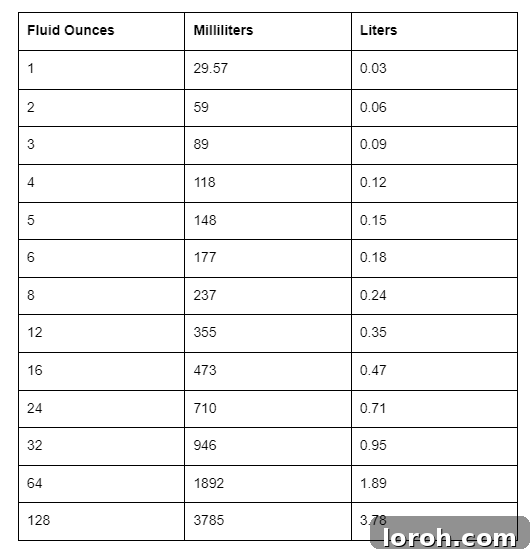
This chart is invaluable for quickly estimating or verifying conversions, for example, seeing that 8 fl oz is roughly 240 ml, which is a common conversion for a standard cup.
Convert Liters to Milliliters to Fluid Ounces
Refer to this chart if you need to convert from metric liters or milliliters to Imperial (US customary) ounces. These conversions are based on 1 ml ≈ 0.0338 fl oz.
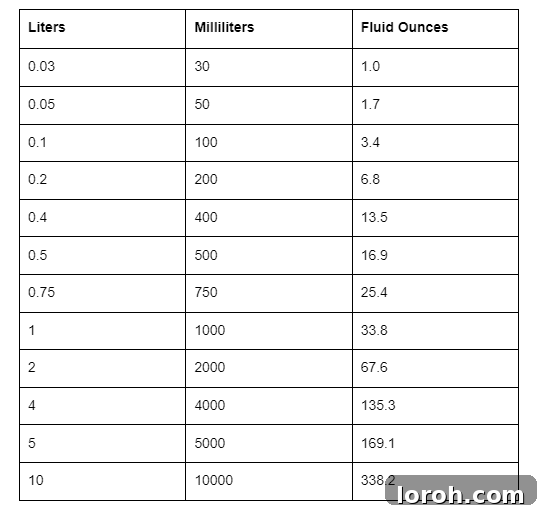
These charts serve as excellent memory aids and quick checks, especially when dealing with standard recipe quantities. For highly precise applications, always revert to the exact conversion factors and a calculator.
Frequently Asked Questions About ML and OZ Conversions
No, 30 milliliters is not exactly the same as 1 US fluid ounce, although they are very close in value. One US fluid ounce is equivalent to approximately 29.5735 milliliters. Therefore, 30 milliliters is slightly more than 1 fluid ounce by about 0.4265 ml.
One US fluid ounce is approximately equal to 29.5735 milliliters. For most practical cooking and baking purposes, 29.57 ml or even 29.6 ml is a sufficiently accurate conversion.
To convert 2 fluid ounces to milliliters, you multiply 2 by the conversion factor: 2 fl oz × 29.5735 ml/fl oz = 59.147 milliliters. So, two fluid ounces is approximately equal to 59.147 milliliters.
Many recipes, especially older ones or those prioritizing simplicity over extreme precision, will round 1 fluid ounce to a convenient 30 ml. This makes mental math easier and is often sufficient for less precise cooking tasks. However, for baking or sensitive recipes, using the more accurate 29.57 ml is recommended.
Yes, for water, a kitchen scale can be very accurate because 1 milliliter of water weighs almost exactly 1 gram. For other liquids with different densities (like oil or honey), weighing will not directly convert to milliliters without knowing the liquid’s specific density. Volumetric measuring cups are generally preferred for liquids unless a recipe specifically asks for liquid by weight.
Conclusion: Mastering Your Kitchen Measurements
Understanding the relationship between milliliters and ounces is an indispensable skill for anyone who spends time in the kitchen. With approximately 29.57 milliliters in a US fluid ounce, this key conversion factor empowers you to accurately measure liquid ingredients, adapt recipes from around the globe, and ensure consistent, delicious results every time. We’ve explored the crucial distinction between fluid ounces (volume) and regular ounces (weight), delved into the metric system’s simplicity with milliliters, and provided clear conversion methods for both directions.
By embracing these conversions, employing practical measurement techniques, and avoiding common pitfalls, you gain the confidence to tackle any recipe, regardless of its origin or specified units. This knowledge not only enhances your culinary precision but also opens up a world of diverse flavors and techniques previously limited by measurement barriers. So go forth, measure confidently, and enjoy the art of cooking and baking with newfound mastery!
More Helpful Resources for Kitchen Conversions
To continue your journey towards complete measurement mastery, explore these related guides:
- How Many Ounces in a Pound (A Conversion Guide)
- How Many Ounces in a Pint? (Conversion Guide)
- How Many Ounces Are in a Cup? (Dry and Liquid Measurements)
- How Many Ounces Are in a Quart? (Conversion Guide)
- Grams to Ounces Conversion: Your Ultimate Kitchen Guide