
How Many Cups Are in a Gallon? Your Ultimate Guide to Liquid Measurement Conversions
Have you ever found yourself in the middle of a recipe, only to pause and wonder, “Exactly how many cups are in a gallon?” You’re certainly not alone! This common culinary conundrum can quickly turn a fun cooking or baking session into a moment of uncertainty. Understanding fundamental liquid measurement conversions is absolutely essential for achieving perfect results in the kitchen, ensuring your dishes turn out exactly as intended, whether you’re a seasoned chef or just starting your culinary journey.
This comprehensive guide is designed to demystify gallon to cup conversions and related measurements. We’ll explore the definitions of key units like cups, pints, quarts, and gallons, clarify the differences between US Customary and Imperial systems, and provide you with simple techniques, helpful charts, and practical tips to master liquid measurements. By the end of this article, you’ll have the confidence to tackle any recipe, scale ingredients effortlessly, and avoid common measurement mistakes.
What is a Cup? Understanding a Fundamental Unit
A cup is a widely recognized unit of volume measurement, particularly prominent in cooking and baking. In the United States, a standard measuring cup is defined as 8 fluid ounces, which is approximately 240 milliliters. This unit is versatile, used for measuring both liquid ingredients (like water, milk, and oil) and dry ingredients (such as flour, sugar, and grains).
Modern measuring cups often feature clear markings for various fractions, including 1/4, 1/3, 1/2, and 3/4 cups. These divisions are crucial for precise recipe execution. However, it’s important to note that measuring cups are typically designed specifically for either liquid or dry ingredients. Liquid measuring cups usually have a spout and extra space above the highest marking to prevent spills, and are read at eye level. Dry measuring cups, on the other hand, are designed to be filled to the brim and leveled off for accuracy, ensuring consistent results in baking where precision is paramount.
What is a Gallon? A Large Volume Measurement
A gallon represents a larger unit of volume measurement used in both the US Customary System and the Imperial System. While the term “gallon” is shared, their exact volumes differ significantly, which is a crucial distinction for international recipes or understanding older cookbooks.
- In the U.S. Customary System: A US gallon is equivalent to 128 fluid ounces, which is approximately 3.785 liters. This is the standard gallon you encounter for everyday items like milk, water jugs, and gasoline in the United States.
- In the Imperial System: Predominantly used in the United Kingdom and some Commonwealth nations, an Imperial gallon amounts to 160 fluid ounces, or about 4.546 liters.
Gallons are commonly used for measuring substantial quantities of liquids, from beverages and cooking oils to paints and fuel. Understanding which system a recipe or product refers to is vital to avoid significant measurement errors.
Imperial Gallon vs. US Customary Gallon: A Critical Difference
The distinction between the Imperial gallon and the US Customary gallon is a frequent point of confusion, especially for those working with recipes or products from different regions. While both systems originated from historical British measurements, they diverged over time.
- The Imperial gallon, still in use in the UK, Canada (though predominantly metric), and some Caribbean nations, is a larger unit. It’s defined as the volume of 10 pounds of water at 62°F (17°C), equating to exactly 4.54609 liters or 160 fluid ounces.
- The US Customary gallon, in contrast, is based on a wine gallon that was adopted in the American colonies. It is equivalent to 231 cubic inches, which translates to exactly 3.785411784 liters or 128 fluid ounces.
This difference means an Imperial gallon is approximately 20% larger than a US gallon. For most home cooks in the US, references to “gallons” in recipes or product packaging will refer to the US Customary gallon. However, awareness of the Imperial gallon is crucial if you’re following international recipes or purchasing products from countries that use the Imperial system.
Dry Gallon vs. Liquid Gallon: Dispelling Measurement Myths
While the concept of a “dry gallon” exists, it’s largely obsolete in modern cooking and can lead to significant confusion if not properly understood. For practical purposes in the kitchen, nearly all references to “gallons” imply a liquid gallon.
- A liquid gallon, as discussed, is the standard unit for measuring liquids like water, milk, juice, or oil. In the US, it contains 128 fluid ounces. This is the gallon you use when following almost any contemporary recipe.
- A dry gallon is an historical unit, equivalent to 1/8th of a US Winchester bushel. It measures approximately 4.40488 liters or 148.94 fluid ounces. Historically, it was used for dry goods like grains, fruits, and vegetables. However, it’s rarely, if ever, used in modern culinary contexts. When measuring dry ingredients today, you’ll typically use cups, ounces (by weight), or grams.
Therefore, when a recipe calls for a “gallon,” you should always assume it’s referring to a liquid gallon. For dry ingredients, stick to measuring by cups (volume) or, even better, by weight (grams or ounces) for maximum accuracy, especially in baking.
The Answer: How Many Cups Are in a Gallon?
Let’s get straight to the core question: There are 16 cups in one US Customary gallon. This is the fundamental conversion factor you need to remember for nearly all your cooking and baking adventures in the United States. Knowing this allows you to confidently scale recipes up or down, measure ingredients accurately, and ensure your culinary creations consistently turn out perfect.
Breaking Down the Gallon: A Step-by-Step Conversion
To fully grasp the 16-cup equivalence, let’s break down the gallon into its constituent units: quarts, pints, and cups. This hierarchical understanding makes the conversion much easier to visualize and remember.
- Gallons to Quarts: One gallon is equal to 4 quarts. Imagine a gallon jug being divided into four equal, smaller containers. Each of those would be a quart.
- Quarts to Pints: Each quart is equal to 2 pints. So, if you have 4 quarts (one gallon), you have 4 x 2 = 8 pints.
- Pints to Cups: Each pint is equal to 2 cups. Following our previous calculation, if you have 8 pints (one gallon), you have 8 x 2 = 16 cups!
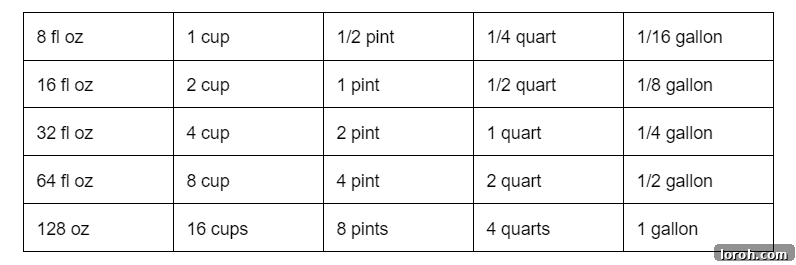
So, the math is simple: 1 Gallon = 4 Quarts = 8 Pints = 16 Cups. This consistent relationship across these volume units makes converting between them straightforward.
Understanding Related Conversions: Quarts, Pints, and Fluid Ounces
How Many Cups in a Quart?
Converting cups to quarts (and vice versa) is a common task in the kitchen. As established above, 1 quart equals 4 cups. This means each cup represents one-fourth of a quart. To elaborate further on their fluid ounce equivalents:
- A standard US cup contains 8 fluid ounces.
- A standard US quart contains 32 fluid ounces (4 cups x 8 fl oz/cup).
This conversion is particularly useful when you’re working with recipes that specify quantities in quarts, but your measuring tools are primarily in cups. For example, if a recipe calls for 2 quarts of broth, you know you’ll need 8 cups (2 quarts * 4 cups/quart).
How Many Cups in a Pint?
The relationship between pints and cups is also very straightforward: there are 2 cups in a pint. This makes each cup equivalent to half of a pint. Understanding this conversion is incredibly helpful for scaling recipes or when you need to substitute ingredients.
- A standard US cup contains 8 fluid ounces.
- A standard US pint contains 16 fluid ounces (2 cups x 8 fl oz/cup).
For instance, if a recipe requests 1 pint of heavy cream, but you only have measuring cups, you can confidently measure out 2 cups instead. This saves you from needing a specialized pint container and ensures you maintain accuracy in your measurements, contributing to consistent and delicious results in your cooking and baking.
The Role of Fluid Ounces
Fluid ounces are the smallest commonly used liquid volume unit in the US Customary system, serving as the building blocks for larger units:
- 1 cup = 8 fluid ounces
- 1 pint = 16 fluid ounces
- 1 quart = 32 fluid ounces
- 1 gallon = 128 fluid ounces
Understanding these relationships provides a solid foundation for any liquid measurement conversion you might encounter.
Practical Applications and Tips for Accurate Measurement
Knowing the conversions is one thing; applying them accurately in the kitchen is another. Here are some practical scenarios and tips to ensure your measurements are always spot-on:
- Scaling Recipes: Whether you’re doubling a recipe for a party or halving it for a smaller meal, these conversions are invaluable. If a recipe calls for 1/2 gallon of stock and you need to double it, you know that’s 1 gallon, or 16 cups.
- Meal Prep and Batch Cooking: For large-scale cooking, knowing how many cups are in a gallon simplifies measuring ingredients like water for soups, broths, or large batches of iced tea or lemonade.
- Baking Precision: While liquid measurements are more forgiving than dry weight in baking, accurate liquid volumes are still critical for the right consistency and texture of batters and doughs.
- Using the Right Tools: Always use liquid measuring cups for liquids (read at eye level on a flat surface) and dry measuring cups for dry ingredients (level off with a straight edge). This minimizes parallax error and ensures consistent volume.
- Don’t Confuse Fluid Ounces with Weight Ounces: A common mistake! Fluid ounces measure volume, while weight ounces measure mass. 8 fluid ounces of water weighs approximately 8 ounces, but 8 fluid ounces of flour will weigh differently due to its density. Recipes typically specify “fl oz” for liquids and “oz” (by weight) for dry ingredients if precision is needed.
Quick Conversion Chart: Gallons, Quarts, Pints, and Cups
For quick reference, here’s a handy conversion chart summarizing the relationships between these common liquid volume units:
| Unit | Equivalent in Cups (US) | Equivalent in Fluid Ounces (US) |
|---|---|---|
| 1 Gallon | 16 cups | 128 fl oz |
| 1/2 Gallon | 8 cups | 64 fl oz |
| 1 Quart | 4 cups | 32 fl oz |
| 1 Pint | 2 cups | 16 fl oz |
| 1 Cup | 1 cup | 8 fl oz |
Frequently Asked Questions About Liquid Measurements
No, 4 cups do not equal 1 gallon. In the United States Customary System, 1 gallon is equal to 16 cups. Therefore, 4 cups would only be equal to 1 quart, or one-fourth (1/4) of a gallon.
No, 1 gallon is not equal to 8 cups. One US Customary gallon is equivalent to 16 cups. If a recipe calls for a gallon of an ingredient, you need to use 16 cups to meet that measurement. Eight cups would be equivalent to half a gallon.
A US Customary gallon is equivalent to 128 fluid ounces. Since a standard US measuring cup holds 8 fluid ounces, you can calculate the number of cups by dividing 128 fluid ounces by 8 fluid ounces per cup, which equals 16 cups in a gallon.
Since there are 16 cups in a full gallon, a half gallon contains exactly 8 cups.
The difference stems from historical divergences in measurement standards. The US gallon is based on an older English wine gallon, while the Imperial gallon (used in the UK) was redefined in the 19th century based on the volume of 10 pounds of water. This led to the US gallon being smaller (128 fl oz) than the Imperial gallon (160 fl oz).
In Conclusion: Master Your Measurements, Master Your Kitchen
Mastering the conversion between cups and gallons, along with quarts and pints, is a foundational skill for anyone with a passion for cooking or baking. Understanding that there are 16 cups in a US Customary gallon empowers you to measure ingredients accurately, confidently adjust recipes for different serving sizes, and navigate any culinary challenge with ease.
This precision is not just about following instructions; it’s about achieving consistent, delicious results every time you step into the kitchen. By internalizing these basic liquid measurement conversions, you gain the confidence to experiment, innovate, and truly make every dish your own. So, next time a recipe calls for a gallon, you’ll know exactly how many cups to reach for, ensuring your culinary creations are always a success!
More Helpful Resources for Kitchen Conversions
- How Many Ounces in a Pound (A Conversion Guide)
- How Many Ounces in a Pint? (Conversion Guide)
- How Many Ounces Are in a Cup? (Dry and Liquid Measurements)
- How Many Ounces Are in a Quart? (Conversion Guide)