
How Many Quarts in a Gallon? The Ultimate Liquid Measurement Conversion Guide
Navigating the intricate world of kitchen measurements can often be a source of confusion, especially when you’re in the midst of preparing a culinary masterpiece. The challenge is compounded by the variations between different measurement systems – primarily the US customary system and the British Imperial system – and the distinction between liquid and dry ingredients. Whether you’re a seasoned chef or just starting your culinary journey, mastering these conversions is paramount for achieving consistent and delicious results.
This comprehensive guide is designed to demystify liquid volume conversions, focusing specifically on the relationship between gallons and quarts. We’ll provide you with clear explanations, practical formulas, and essential tips to help you confidently convert measurements for any recipe, ensuring your dishes always turn out perfectly. Say goodbye to measurement mishaps and hello to culinary precision!
Table of Contents
- Quick Conversion Table: Quarts to Gallons
- What is a Quart?
- Wet vs. Dry Quart Explained
- What is a Gallon?
- US Customary Gallon vs. Imperial Gallon
- Liquid Gallon vs. Dry Gallon
- Formula to Convert Quarts and Gallons
- Practical Tips for Accurate Measurements
- Frequently Asked Questions
- More Helpful Resources
Quick Conversion Table: Quarts to Gallons
For immediate reference, this table offers a concise overview of common quart to gallon conversions. While we will provide detailed explanations and formulas further down, this quick look can be incredibly useful when you need a fast conversion.
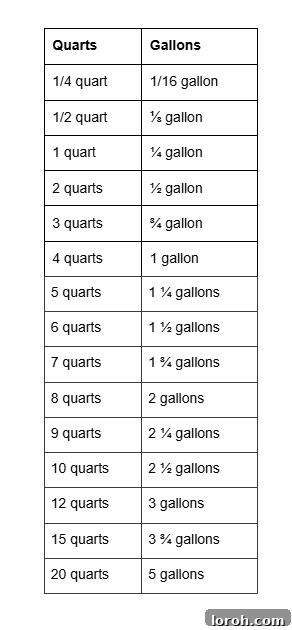
Here’s a straightforward text-based table to complement the visual guide:
| Quarts (qt) | Gallons (gal) |
|---|---|
| 1 | 0.25 (or 1/4) |
| 2 | 0.5 (or 1/2) |
| 3 | 0.75 (or 3/4) |
| 4 | 1 |
| 8 | 2 |
| 12 | 3 |
| 16 | 4 |
| 20 | 5 |
What is a Quart?
A quart, commonly abbreviated as ‘qt’, is a unit of liquid volume measurement that plays a significant role in both the US customary and Imperial systems. Its very name, derived from the Latin word ‘Quartus’ (meaning “a fourth”) and the Old French ‘Quarte’ (meaning a “¼ portion”), precisely defines its relationship to a larger unit: a quart is exactly one-fourth (1/4) of a gallon.
In the United States, a US liquid quart is specifically defined as 32 fluid ounces (fl oz), which is equivalent to 2 pints or approximately 0.946 liters. This unit is frequently encountered in everyday life, from the grocery store to the kitchen. You’ll commonly find products like milk, juice, ice cream, and even motor oil packaged and sold in quart-sized containers. Its convenient size makes it ideal for measuring moderate quantities of liquids in recipes, making it a staple in any home cook’s arsenal.
Key Characteristics and Equivalents of a US Liquid Quart:
- Etymological Roots: Latin ‘Quartus’ and Old French ‘Quarte’, both denoting a quarter.
- Relation to a Gallon: Precisely 1/4 of a US customary gallon.
- Fluid Ounces: Contains 32 US fluid ounces.
- Pints: Equal to 2 US customary pints.
- Cups: Equal to 4 US customary cups.
- Metric Equivalent (approximate): 0.946 liters.
- Common Usage: Ideal for measuring liquids in recipes and for packaging everyday food and household items.
Wet vs. Dry Quart Explained
While the term “quart” typically refers to a liquid measurement, it’s important to acknowledge a historical distinction between “wet” (liquid) quarts and “dry” quarts. This difference, though largely outdated for modern cooking, highlights how varying densities and historical measurement practices influenced volume definitions.
A liquid quart (or wet quart) is the standard unit used for all fluid ingredients. In the US customary system, it always contains 32 fluid ounces. This volume remains consistent whether you’re measuring water, oil, milk, or any other liquid, as liquids conform to the shape of their container and maintain a uniform density.
A dry quart, conversely, was historically employed to measure the volume of dry commodities like fruits (especially berries), grains, and other agricultural produce. The key difference is that dry ingredients can be packed more or less densely, affecting the actual mass within a given volume. For this reason, a US dry quart is actually larger than a US liquid quart. Specifically, a US dry quart holds approximately 37.23 fluid ounces (or about 1.101 liters), based on the Winchester bushel system, which was used for dry measures.
In contemporary culinary practices and product labeling, you will almost exclusively encounter the liquid quart. Recipes calling for dry ingredients are typically measured by weight (e.g., ounces or grams) for greater accuracy, or by volume using dry measuring cups. The dry quart is rarely, if ever, used in modern kitchens. However, understanding this distinction is valuable for anyone delving into historical recipes or specialized agricultural contexts, where these older units might still be referenced.
What is a Gallon?
A gallon stands as a foundational unit of volume measurement, predominantly used in the United States customary system and, with a different value, in the British Imperial system. It serves as a large-capacity unit, making it a ubiquitous measurement for bulk liquids across various sectors, from retail to industrial applications.
In the US customary system, a gallon is precisely defined as 231 cubic inches. This translates to 128 fluid ounces, or more simply, 4 US liquid quarts. It is also equivalent to 8 US pints or 16 US cups. In metric terms, one US gallon is approximately 3.785 liters. This unit is ingrained in American daily life, most notably for measuring fuel (gasoline) at the pump, packaging large quantities of milk, water, and juice, and for estimating capacities in gardening or home improvement projects.
The history of the gallon is complex, evolving from various historical liquid measures in England. Different “gallons” existed (like the wine gallon, ale gallon, and corn gallon) before standardization. The US adopted the Queen Anne wine gallon as its standard, leading to the 231 cubic inch definition we use today. This larger unit provides a practical way to quantify substantial liquid volumes, streamlining commerce and consumption.
Common Applications of a US Gallon:
- Automotive: Measuring fuel consumption and purchasing gasoline.
- Food & Beverage: Packaging milk, water, and other beverages in family-sized containers.
- Household: Measuring paint, cleaning solutions, or estimating the capacity of large pots and containers.
- Gardening & Agriculture: Quantifying water for irrigation or chemicals for treatments.
US Customary Gallon vs. Imperial Gallon
One of the most significant sources of confusion in international measurement conversions is the existence of two distinct “gallons”: the US customary gallon and the Imperial gallon. While both are used to measure liquid volume, they are not interchangeable and represent different quantities. Understanding this difference is crucial, especially when following recipes or instructions from different parts of the world.
The US Customary Gallon
The US customary gallon, often simply called “gallon” within the United States, is the standard liquid volume unit in the US. Its definition is rooted in the 18th-century British wine gallon. Its precise equivalences are:
- Volume: 231 cubic inches
- Fluid Ounces: 128 US fluid ounces
- Quarts: 4 US liquid quarts
- Pints: 8 US liquid pints
- Cups: 16 US liquid cups
- Metric Equivalent (approximate): 3.785 liters
This is the measurement system you will encounter in nearly all American cookbooks, product labels, and daily transactions. It is the gallon commonly used for fuel, milk, and other liquids throughout the United States and some regions influenced by the US system.
The Imperial Gallon
The Imperial gallon, on the other hand, is the official unit of liquid volume within the British Imperial system. This system is used in the United Kingdom, Canada (though often alongside metric units), and several Commonwealth countries. The Imperial gallon is significantly larger than the US gallon, originally defined as the volume occupied by 10 pounds of distilled water at 62°F (17°C).
Its precise equivalences are:
- Volume: 277.42 cubic inches
- Fluid Ounces: 160 Imperial fluid ounces
- Quarts: 4 Imperial quarts
- Pints: 8 Imperial pints
- Metric Equivalent (approximate): 4.546 liters
The Imperial gallon is approximately 20% larger than the US gallon. This substantial difference means that substituting one for the other in a recipe or conversion without proper adjustment can lead to incorrect results. For example, a recipe calling for “1 gallon” from a British cookbook requires a significantly larger volume of liquid than the same instruction in an American cookbook. Always verify the origin of your recipe or measurement reference to ensure you’re using the correct gallon.
Liquid Gallon vs. Dry Gallon
Similar to quarts, there is a historical distinction between liquid gallons and dry gallons. However, it’s imperative to emphasize that the dry gallon is largely obsolete in modern applications, particularly in cooking and retail. When the term “gallon” is used today, it almost universally refers to the liquid gallon.
The Liquid Gallon
The liquid gallon is the standard unit for measuring any fluid. As discussed, in the US customary system, one liquid gallon is precisely 128 fluid ounces, which is equivalent to 4 liquid quarts. This unit is used across all industries for substances that pour and flow, such as water, milk, juice, paint, and gasoline. Its definition is consistent and straightforward, making it easy to use and convert.
The Dry Gallon (An Obsolete Unit)
The dry gallon was a historical unit primarily employed for measuring dry agricultural products like grains, fruits (e.g., apples, potatoes), and vegetables. It was based on the Winchester bushel, a very old English measure. A US dry gallon is approximately 268.8025 cubic inches, which translates to roughly 148.94 fluid ounces or about 4.405 liters. This makes it larger than the US liquid gallon.
The reasons for its decline in usage are clear:
- Inaccuracy: Measuring dry goods by volume can be highly inconsistent. The amount of a substance that fits into a “gallon” can vary significantly based on how tightly it’s packed, its particle size, and shape (e.g., loosely packed flour versus compacted flour).
- Modern Precision: Contemporary cooking and commerce demand greater precision. For dry ingredients, weight measurements (grams, ounces, pounds) are far more accurate and are now the standard.
- Standardization: As measurement systems evolved and became more standardized, less precise and context-dependent units like the dry gallon were phased out.
Therefore, when you encounter “gallon” in any modern context, always assume it refers to the liquid gallon. For dry ingredients in recipes, always defer to weight measurements or specific cup measures provided, and never attempt to use a “dry gallon” equivalent.
Formula to Convert Quarts and Gallons
Converting between quarts and gallons is a simple process, thanks to their direct relationship: there are always 4 quarts in 1 gallon (whether US customary or Imperial, the relationship within each system is 4 quarts to 1 gallon).
Converting Quarts to Gallons
To determine how many gallons are in a given number of quarts, you use division. You simply take the total number of quarts and divide it by 4.
Formula: Gallons = Number of Quarts ÷ 4
Practical Examples:
- Scenario 1: You have 8 quarts of homemade chicken stock and want to know how many gallons that is.
8 quarts ÷ 4 = 2 gallons - Scenario 2: A recipe calls for 10 quarts of water. How many gallons do you need?
10 quarts ÷ 4 = 2.5 gallons - Scenario 3: You have 3 quarts of juice. What fraction of a gallon is that?
3 quarts ÷ 4 = 0.75 gallons (or 3/4 of a gallon)
Converting Gallons to Quarts
Conversely, if you know the number of gallons and need to find out how many quarts that represents, you use multiplication. You multiply the number of gallons by 4.
Formula: Quarts = Number of Gallons × 4
Practical Examples:
- Scenario 1: You bought a 5-gallon container of water. How many quarts does it hold?
5 gallons × 4 = 20 quarts - Scenario 2: A large-batch recipe requires 3.5 gallons of liquid. How many quarts is that?
3.5 gallons × 4 = 14 quarts - Scenario 3: You need a quarter of a gallon for a specific step. How many quarts is that?
0.25 gallons × 4 = 1 quart
These straightforward formulas provide a reliable method for converting between quarts and gallons, whether you’re scaling a recipe, purchasing ingredients, or simply understanding quantities.
Practical Tips for Accurate Measurements
Beyond understanding the conversion formulas, precision in measurement is a cornerstone of successful cooking and baking. Even minor errors can significantly impact the outcome of a dish. Here are some indispensable tips to ensure your measurements are always accurate:
- Use the Right Tools: Always distinguish between liquid measuring cups (clear, with a spout, and measurements below the rim for easy viewing) and dry measuring cups (designed to be leveled off). Using the wrong type can lead to inaccurate readings.
- Measure Liquids at Eye Level: When measuring liquids, place the measuring cup on a flat, level surface and bend down to view the liquid’s surface at eye level. Read the measurement from the bottom of the meniscus (the slight curve in the liquid’s surface).
- Level Off Dry Ingredients Properly: For dry ingredients measured by volume (like flour or sugar, if not by weight), spoon the ingredient loosely into the cup until it overflows. Then, use the flat edge of a knife or a straight spatula to sweep across the top, leveling it off. Avoid compacting the ingredient unless the recipe specifically states “packed.”
- Prioritize Weight for Dry Ingredients: For baking, especially, measuring dry ingredients by weight (using a digital kitchen scale) is far more accurate than by volume. This eliminates variables like how tightly an ingredient is packed or humidity levels, which can alter volume.
- Be Mindful of US vs. Imperial: As highlighted, the volumes of gallons, quarts, pints, and fluid ounces differ significantly between the US customary and British Imperial systems. Always confirm which system a recipe or instruction is using.
- Convert Strategically: If a recipe calls for a unit you don’t have a specific measuring tool for, convert it to a unit you do have. For example, if you need 1 gallon but only have a quart measure, convert to 4 quarts and measure four times.
- Account for Viscosity: For very thick liquids like honey or syrup, lightly coat the measuring cup with oil or cooking spray beforehand to help the ingredient slide out easily, ensuring you get the full amount.
- Clean Your Measuring Tools: Residue from previous ingredients can affect the accuracy of subsequent measurements. Always ensure your measuring cups and spoons are clean and dry.
By integrating these practical tips into your culinary routine, you’ll minimize errors and enhance the consistency and quality of your dishes, turning every cooking and baking endeavor into a success.
Frequently Asked Questions
There are 4 US liquid quarts in 1 US customary gallon. Similarly, there are 4 Imperial quarts in 1 Imperial gallon.
In the US customary system, there are 128 fluid ounces in 1 gallon. In the Imperial system (UK), there are 160 fluid ounces in 1 gallon.
There are 16 US customary cups in 1 US customary gallon. This is because 1 gallon equals 4 quarts, and 1 quart equals 4 cups (4 x 4 = 16).
There are 8 US customary pints in 1 US customary gallon. This is calculated because 1 gallon equals 4 quarts, and 1 quart equals 2 pints (4 x 2 = 8).
There is one-quarter of a gallon (0.25 gallons) in 1 quart.
‘Qt’ is the widely recognized abbreviation for quarts.
‘Gal’ is the widely recognized abbreviation for gallons.
To convert quarts to gallons, you simply divide the number of quarts by four. The formula is: Gallons = Number of Quarts ÷ 4. For instance, 12 quarts divided by 4 equals 3 gallons.
No, a US gallon is not the same as a UK (Imperial) gallon. A US gallon is smaller, containing 128 fluid ounces, while a UK Imperial gallon contains 160 fluid ounces. This difference is crucial for accurately interpreting international recipes and product measurements.
More Helpful Resources
Expand your knowledge of kitchen measurements and conversions with these additional helpful guides:
- How Many Ounces in a Pound (A Conversion Guide)
- How Many Ounces in a Pint? (Conversion Guide)
- How Many Ounces Are in a Cup? (Dry and Liquid Measurements)
- How Many Ounces Are in a Quart? (Conversion Guide)
- How Many Pints in a Quart? (Measurement Guide)