
How Many Cups in a Quart? The Ultimate Kitchen Conversion Guide
Have you ever found yourself in the middle of a recipe, paused by the crucial question: “How many cups are in a quart?” You’re certainly not alone! This common culinary conundrum can quickly halt your cooking or baking progress. Understanding fundamental kitchen conversions isn’t just about getting through a recipe; it’s about building confidence, preventing costly mistakes, and mastering the art of the kitchen. Whether you’re a beginner learning the ropes or an experienced home cook tackling an unfamiliar recipe, precise measurements are the bedrock of successful culinary endeavors.
In this comprehensive guide, we’ll demystify the conversion from cups to quarts and beyond. We’ll delve into the specifics of these common liquid measurement units, provide easy-to-read conversion charts, and share practical tips to make kitchen math a breeze. By the end of this article, you’ll be able to effortlessly convert between cups, quarts, pints, and even gallons, transforming you into a more confident and efficient cook or baker. Get ready to unlock the secrets to perfect culinary measurements!
Table of Contents
- How Many Cups in a Quart? The Core Conversion
- What Exactly is a Cup?
- What Exactly is a Quart?
- Cups to Quarts Conversion Tables
- Understanding the US Customary System: Cups, Pints, Quarts, Gallons
- Why Accurate Kitchen Measurements Are Crucial
- Practical Tips for Easy Kitchen Conversions
- Frequently Asked Questions About Kitchen Conversions
- More Helpful Resources and Conversion Charts
How Many Cups in a Quart? The Core Conversion
Let’s get straight to the heart of the matter. The most fundamental conversion you need to remember for liquid measurements in the US customary system is simple:
- There are 4 cups in 1 quart.
- Conversely, one cup is equivalent to ¼ quart.
This simple relationship is the foundation for many other kitchen conversions. To put it into perspective with fluid ounces, which are often used for smaller measurements:
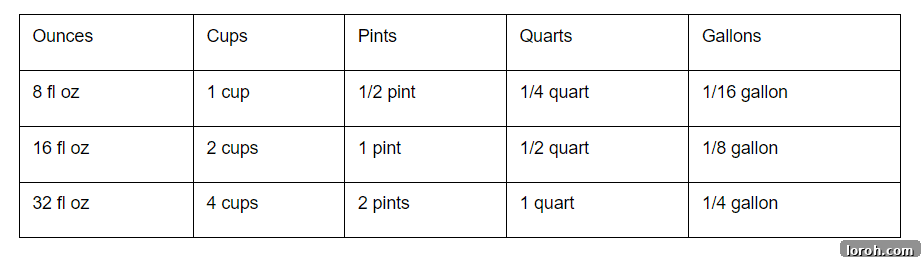
- A single cup measures 8 fluid ounces.
- A single quart contains 32 fluid ounces.
Understanding these basic equivalencies allows you to easily scale recipes up or down without hassle. For instance, if a recipe calls for two quarts of broth, you instantly know you’ll need 8 cups. Similarly, if you only have a 2-cup measuring pitcher, you understand that two full pitchers will make half a quart, and four will make a full quart. This knowledge empowers you to confidently approach any recipe, regardless of the units it uses.
What Exactly is a Cup?
A “cup” is a standard unit of volume measurement universally adopted in cooking and baking recipes, particularly in the United States. While its exact volume can vary slightly internationally, in the United States customary system, a standard cup is defined as 8 fluid ounces. This equates to approximately 240 milliliters (ml) when converting to the metric system, though for precision, 236.588 ml is the precise US fluid cup conversion.
Cups are versatile and used to measure a wide array of both liquid and dry ingredients. For liquids like water, milk, or oil, you typically fill the measuring cup to the indicated line. For dry ingredients such as flour, sugar, or rice, it’s crucial to measure correctly. For example, flour should often be spooned into the cup and then leveled off with a straight edge, rather than scooped directly, to prevent compaction and inaccurate measurements.
It’s important to note that while a cup is a standard unit, the type of measuring cup matters. Liquid measuring cups usually have a spout and measurements on the side for easy pouring and reading at eye level, while dry measuring cups are designed to be filled to the brim and leveled off for accuracy.
What Exactly is a Quart?
The term “quart,” often abbreviated as “qt,” is another vital unit of volume measurement, predominantly used for liquid ingredients. Its etymology is quite interesting, tracing back to the Latin word ‘Quartus,’ meaning “a fourth,” and the Old French word ‘Quarte,’ also signifying a “quarter portion.” This historical context perfectly illustrates its definition within measurement systems.
In the United States customary system, a quart is precisely equivalent to 32 fluid ounces. This makes it a convenient unit for larger quantities of liquids, such as milk, juice, soups, or broths. For instance, a standard carton of milk in the US often comes in quarts or half-gallons.
It’s worth noting that there is a slight difference between a US customary quart and an imperial quart (used in the UK and some Commonwealth countries). An imperial quart is slightly larger, measuring approximately 40 imperial fluid ounces (about 1.136 liters), compared to the US quart’s 32 US fluid ounces (about 0.946 liters). For the purpose of this guide and typical American recipes, we are focusing on the US customary quart of 32 fluid ounces. Always be mindful of the origin of your recipe when dealing with measurements to ensure accuracy.
Cups to Quarts Conversion Tables
To make your kitchen conversions even easier, here are some helpful tables that illustrate the relationship between cups and quarts, as well as other common liquid measurements.
Detailed Cups to Quarts Conversion Table
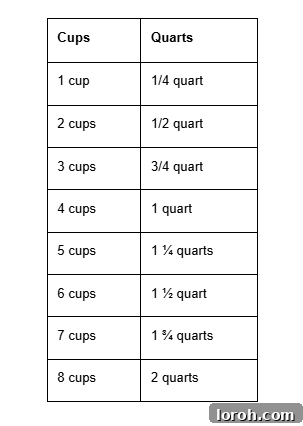
Here’s a quick reference table for common cup-to-quart conversions:
| Cups | Quarts |
|---|---|
| 1 cup | 0.25 quart |
| 2 cups | 0.5 quart (1 pint) |
| 3 cups | 0.75 quart |
| 4 cups | 1 quart |
| 5 cups | 1.25 quarts |
| 6 cups | 1.5 quarts |
| 8 cups | 2 quarts (0.5 gallon) |
| 12 cups | 3 quarts |
| 16 cups | 4 quarts (1 gallon) |
Quick Conversions Chart (General Liquid Measurements)
Understanding the US Customary System: Cups, Pints, Quarts, Gallons
The US customary system of liquid measurement can seem a bit complex at first glance, but it’s built on simple, consistent relationships. Knowing these connections will make any recipe conversion effortless. Here’s how the common units relate to each other:
- Fluid Ounce (fl oz): The smallest common unit.
- Cup (c): 8 fluid ounces.
- Pint (pt): 2 cups, or 16 fluid ounces. The word “pint” actually comes from the Old French ‘pinte’, possibly from Vulgar Latin ‘pincta’, meaning “painted” (perhaps referring to markings on a container).
- Quart (qt): 2 pints, or 4 cups, or 32 fluid ounces. As we’ve discussed, it’s a “quarter” of a gallon.
- Gallon (gal): 4 quarts, or 8 pints, or 16 cups, or 128 fluid ounces. This is the largest common unit for liquids in the kitchen.
A helpful mnemonic device to remember these relationships is often called “Gallon Man” or “The Gallon Kingdom.” Imagine a large “G” for gallon. Inside the “G,” draw four “Q”s for quarts. Inside each “Q,” draw two “P”s for pints. And inside each “P,” draw two “C”s for cups. This visual aid makes remembering the hierarchy and conversions much simpler.
Why Accurate Kitchen Measurements Are Crucial
While some seasoned cooks might boast about their ability to “eyeball” ingredients, for most home cooks, especially when following a new recipe or baking, accuracy in measurement is paramount. Here’s why:
- Baking is a Science: Unlike cooking, where a little more of this or less of that might be forgiven, baking is chemistry. The ratios of ingredients like flour, sugar, leavening agents (baking powder/soda), and liquids are carefully balanced. Even a small deviation, such as using 3 cups instead of 4 for a quart, can drastically alter the texture, rise, and taste of your baked goods. Cakes might be dry, cookies too crumbly, or bread too dense.
- Consistency in Cooking: For recipes like soups, sauces, or gravies, accurate liquid measurements ensure the desired consistency and flavor profile. Too much liquid can dilute flavors or make a sauce watery, while too little can make it overly thick or concentrated. When you find a dish you love, precise measurements help you replicate it perfectly every time.
- Cost-Effectiveness: Incorrect measurements can lead to wasted ingredients. Imagine ruining a batch of expensive ingredients because of a simple conversion error. Accurate measurements save you money and prevent frustration.
- Following Recipes Globally: Many recipes originate from different parts of the world, utilizing various measurement systems (e.g., metric). Even within the imperial system, variations exist (US vs. UK). Understanding how to convert between units, or at least knowing the standard for your region, prevents misinterpretations of recipes.
In essence, taking the time to measure correctly, or convert measurements accurately, is an investment in the success of your dish and your enjoyment in the kitchen.
Practical Tips for Easy Kitchen Conversions
Making conversions on the fly can be challenging, especially when you’re busy cooking. Here are some tips to make it simpler:
- Keep a Chart Handy: Print out a conversion chart (like the ones above) and stick it on your fridge or inside a cupboard door. Quick visual access is invaluable.
- Invest in a Good Measuring Set: Have a complete set of US standard measuring cups and spoons for both dry and liquid ingredients. A large liquid measuring cup that goes up to 8 cups (2 quarts) or even a gallon is incredibly useful.
- Use Online Converters: If you’re unsure, a quick search on your phone for “cups to quarts converter” will give you instant, accurate results.
- Practice Mental Math: Over time, repeatedly converting 4 cups to 1 quart will make it second nature. Start with simple multiples (e.g., 8 cups = 2 quarts, 12 cups = 3 quarts).
- Focus on the US Customary System: Most recipes found online or in US cookbooks will use the US customary system. Familiarize yourself thoroughly with it first, before venturing into international recipes that might use the imperial system or metric.
Frequently Asked Questions About Kitchen Conversions
There are exactly 4 cups in 1 US customary quart.
Since there are 4 cups in one quart, to find the number of cups in two quarts, you multiply 4 cups/quart by 2 quarts. This equals 8 cups.
There are 2 cups in a US customary pint. This means a pint is exactly half of a quart.
There are 2 pints in a US customary quart. This is why a half-quart is often referred to as a pint.
There are 4 quarts in a US customary gallon. This is where the term “quart” (meaning a quarter) originates.
To find the number of cups in a gallon, you can multiply the number of quarts in a gallon (4) by the number of cups in a quart (4). So, 4 quarts * 4 cups/quart = 16 cups in a gallon.
While similar, US customary and imperial (UK) measurements have different definitions for some units. For liquids, a US fluid ounce is slightly larger than an imperial fluid ounce, leading to a US quart (32 fl oz) being smaller than an imperial quart (40 fl oz). This difference is important when using recipes from other countries.
While technically possible, it’s best to use separate measuring tools. Liquid measuring cups (clear, with a spout, read at eye level) are designed for liquids, and dry measuring cups (solid, for leveling off) are designed for dry ingredients. Using the correct tools ensures greater accuracy.
More Helpful Resources and Conversion Charts
Expanding your knowledge of kitchen measurements will make you an even more versatile cook. Explore these related guides for further insights into common conversions:
Helpful Tips
How Many Ounces Are in a Quart? (Conversion Guide)
Helpful Tips
How Many Tablespoons Are in a Cup? (Conversion Guide)
Helpful Tips
How Many Ounces Are in a Cup? (Dry and Liquid Measurements)
Helpful Tips
How Many Ounces in a Pint? (Conversion Guide)
- How Many Pints in a Quart (A Conversion Guide)
- How Many Ounces in a Pint? (Conversion Guide)
- How Many Ounces Are in a Cup? (Dry and Liquid Measurements)
- How Many Ounces Are in a Quart? (Conversion Guide)
Mastering kitchen conversions, especially understanding how many cups are in a quart, is a vital skill for anyone who loves to cook or bake. By familiarizing yourself with these basic units and their relationships, you’re not just following a recipe; you’re truly understanding the mechanics behind it. This knowledge will empower you to adjust recipes, confidently tackle new culinary challenges, and consistently achieve delicious results. Happy cooking!