
Mastering kitchen measurements is a cornerstone of successful cooking and baking. This comprehensive guide will demystify common kitchen conversions, focusing on how many ounces are in a quart, and providing clear insights into both fluid and dry measurements across imperial and metric systems.
Precision is paramount in the culinary world. Whether you’re a seasoned chef or a novice home cook, accurate measurements can make or break a recipe. Yet, the vast array of units—from teaspoons to gallons, and grams to ounces—can often lead to confusion, especially when a recipe calls for a unit you’re not familiar with or requires a quick conversion. Imagine you’re in the midst of preparing a delicate dessert, and suddenly you need to convert ounces to quarts; fumbling for your phone or a calculator can disrupt your flow and potentially compromise your dish.
To ensure your culinary adventures are always smooth and successful, we’ve crafted this definitive guide. We’ll not only answer the fundamental question of “how many ounces are in a quart?” but also equip you with the knowledge to effortlessly convert between these units and understand their nuances across different measurement systems. Get ready to measure quarts and ounces with absolute confidence, transforming your kitchen into a realm of precision and ease!
Table of Contents
- Understanding the Ounce
- Fluid Ounces vs Dry Ounces Explained
- What is a Quart?
- Wet vs Dry Quart Measurements
- How to Convert Ounces to Quarts: Step-by-Step
- Quick Ounces to Quarts Conversion Table
- Easy Quarts to Ounces Conversion Table
- Imperial, US Customary, and Metric Measurements: A Comparison
- Frequently Asked Questions About Ounces and Quarts
- More Helpful Kitchen Resources
Understanding the Ounce
The ounce, often abbreviated as “oz,” is a foundational unit of measurement with a rich history, dating back to ancient Roman times. Its name is derived from the Latin word “uncia,” meaning “a twelfth part,” referring to its historical definition as one-twelfth of a Roman copper bar. Today, an ounce is primarily used to quantify volume, weight, and mass.
In the culinary context, the ounce is particularly prevalent in the United States, Myanmar, and Liberia for measuring smaller quantities of ingredients. For precise dry measurements, one ounce is equivalent to approximately 28.35 grams. This gram conversion is especially useful when adapting recipes from metric-based cookbooks, as the majority of the world utilizes the metric system, where grams and milliliters are the standard units for smaller measurements.
Understanding the ounce is crucial for accurate recipe execution, ensuring your dishes achieve the intended balance of flavors and textures. Its versatility makes it a common unit for everything from spices and herbs to small amounts of liquids and even precious metals, though our focus here remains squarely on its utility in the kitchen.
Fluid Ounces vs Dry Ounces Explained
One of the most common sources of confusion in kitchen measurements stems from the distinction between fluid ounces and dry ounces. While both use the term “ounce,” they represent entirely different concepts and require different measuring tools.
- Fluid Ounces (fl oz): These are units of volume, used specifically for liquids. When a recipe calls for “ounces” of water, milk, or oil, it’s referring to fluid ounces. They are measured using a liquid measuring cup, which typically has a spout and markings at eye level to ensure accurate readings. One fluid ounce of water occupies a specific volume, regardless of its weight.
- Dry Ounces (oz by weight): These are units of weight, used for solid ingredients like flour, sugar, butter, or chopped vegetables. Dry ounces are measured using a kitchen scale. The weight of a dry ounce will vary depending on the density of the ingredient. For example, one ounce of feathers takes up significantly more space than one ounce of lead, even though they weigh the same. Similarly, one ounce of flour occupies a different volume than one ounce of sugar.
The critical takeaway here is that you cannot simply substitute a fluid ounce measurement for a dry ounce measurement, or vice-versa, unless the recipe specifies a weight for a liquid (e.g., “1 oz of honey by weight”). Always use the appropriate measuring tool: liquid measuring cups for fluid ounces and a digital kitchen scale for dry ounces (weight). Mixing these up is a common mistake that can significantly alter the outcome of your culinary creations.
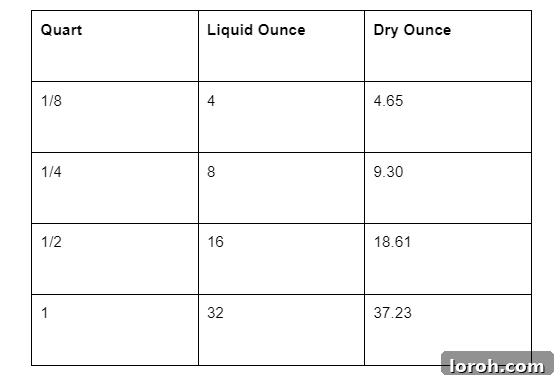
To help visualize these differences and aid in common conversions, refer to the chart below, which illustrates how dry ingredient ounces (by weight) do not directly equate to fluid ounces:
What is a Quart?
A quart, abbreviated as “qt,” is another vital unit of measurement, predominantly used for liquid ingredients within the US Customary System. The term “quart” itself offers a clue to its value, stemming from the Latin word ‘Quartus,’ meaning “a fourth,” and the Old French word ‘Quarte,’ signifying a “¼ portion.” True to its etymology, a quart represents precisely one-fourth of a gallon.
This unit is commonly encountered when purchasing liquids like milk, juice, or larger quantities of broth. Understanding the quart’s place in the hierarchy of liquid measurements—with two pints in a quart and four quarts in a gallon—is essential for scaling recipes up or down efficiently.
For liquid measurements, the definitive conversion to remember is: one liquid quart equals 32 fluid ounces. This fundamental conversion forms the basis for many kitchen calculations and will be explored in detail in the following sections. While primarily associated with liquids, it’s important to note, as we’ll discuss next, that the concept of a “dry quart” also exists, albeit with different values.
Merriam-Webster defines a quart as a unit of liquid capacity equal to 1/4 gallon or 2 pints, or approximately 0.946 liter.
Wet vs Dry Quart Measurements
Just as with ounces, the distinction between wet (liquid) and dry quarts is crucial for accurate cooking and baking. This difference arises from the fundamental principle of density: liquid ingredients are typically less dense and occupy volume differently compared to solid, dry ingredients.
- Liquid (Wet) Quart: This is the most common interpretation of a quart in the kitchen. A liquid quart, such as for water, milk, or oil, contains exactly 32 fluid ounces. It is a measure of volume and is typically measured using liquid measuring cups or containers marked in quarts.
- Dry Quart: While less frequently used in everyday cooking compared to its liquid counterpart, the dry quart is a unit of volume for solid ingredients, particularly common for produce like berries or grains. Because dry ingredients are not uniform in density and pack differently, a dry quart is not equivalent to a liquid quart. Specifically, a dry quart measures out to approximately 37.24 fluid ounces (US) by volume, although it’s often more practical to think of it by weight for specific ingredients. When measuring dry goods, it’s almost always more accurate to use a kitchen scale for weight (e.g., grams or dry ounces) rather than relying on volume units like a dry quart, especially for baking.
The disparity between liquid and dry measurements underscores the importance of context in recipes. If a recipe simply states “1 quart,” it almost invariably refers to a liquid quart, unless it’s explicitly for fruits or vegetables, in which case a dry quart might be implied. Always clarify if unsure, but for most cooking tasks, assume “quart” refers to the liquid measure of 32 fluid ounces.
For related conversions, you might find it helpful to learn how to convert ounces to cups, as cups are often the intermediary unit between ounces and quarts.
How to Convert Ounces to Quarts: Step-by-Step
Converting fluid ounces to quarts is a straightforward process once you know the key conversion factor: there are 32 fluid ounces in one liquid quart. To perform this conversion, you simply need to divide the total number of fluid ounces by 32.
Here’s the simple formula:
Quarts = Total Fluid Ounces / 32
Let’s walk through a few practical examples:
- Example 1: You have 128 fluid ounces of chicken broth and want to know how many quarts that is.
128 fluid ounces / 32 = 4 quarts - Example 2: A recipe calls for 64 fluid ounces of milk. How many quarts do you need?
64 fluid ounces / 32 = 2 quarts - Example 3: If you’re working with 96 fluid ounces of orange juice.
96 fluid ounces / 32 = 3 quarts
This method ensures accuracy, preventing common measurement errors that could impact your recipe’s outcome. Keep this simple division in mind, or refer to a quick conversion chart, to make your kitchen tasks much easier and more precise. For quick reference, consider keeping a small conversion chart taped inside a cupboard door or near your cooking station.
Quick Ounces to Quarts Conversion Table
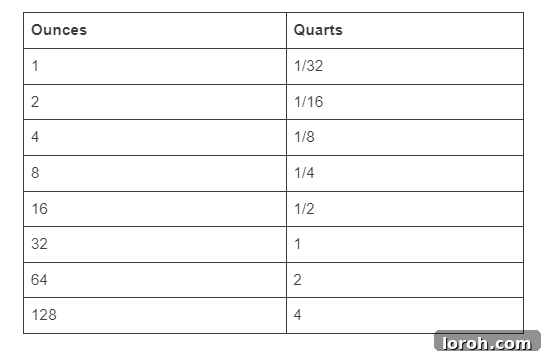
To streamline your cooking and baking process, having a handy conversion table can be invaluable. Instead of performing calculations on the fly, you can quickly reference the chart below to convert common fluid ounce quantities into quarts. This table is designed for ease of use, providing instant answers for frequently encountered measurements.
Use this chart to swiftly determine the equivalent quart value for various fluid ounce amounts, making your kitchen work more efficient and enjoyable:
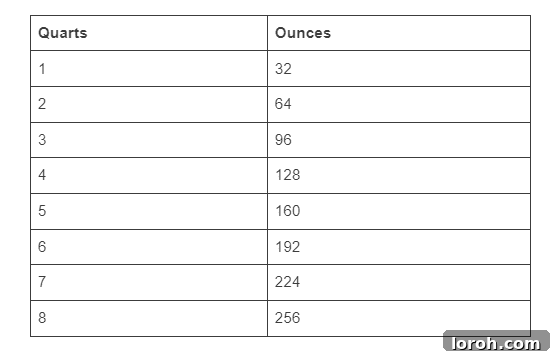
Easy Quarts to Ounces Conversion Table
Sometimes, your recipe might call for quarts, but your measuring tools are in fluid ounces. In such cases, converting quarts back to fluid ounces is just as simple. The process is the inverse of converting ounces to quarts: you multiply the number of quarts by 32 to find the equivalent in fluid ounces.
Here’s the formula:
Fluid Ounces = Number of Quarts * 32
Let’s look at a couple of examples:
- Example 1: A recipe requires 2 quarts of water. How many fluid ounces do you need?
2 quarts * 32 = 64 fluid ounces - Example 2: You need 5 quarts of broth for a large soup.
5 quarts * 32 = 160 fluid ounces
For even quicker conversions without the need for mental math, refer to the conversion table below. It’s a convenient resource for instantly finding the fluid ounce equivalent for various quart measurements, ensuring precision in all your culinary endeavors:
Imperial, US Customary, and Metric Measurements: A Comparison
Navigating the world of kitchen measurements can become even more complex when considering the different systems used globally. The primary systems you’ll encounter are the US Customary System, the Imperial System, and the Metric System. While they all aim to quantify, their specific unit values often differ significantly, leading to potential confusion if not properly understood.
The US Customary System
This system is predominantly used in the United States, and it’s the system we’ve primarily focused on so far in this guide. Key liquid volume units include the fluid ounce, cup, pint, quart, and gallon.
- 1 US Fluid Ounce = approximately 29.57 milliliters (mL)
- 1 US Liquid Quart = 32 US fluid ounces = 4 US cups = 2 US pints = 0.946 liters (L)
The Imperial System
Used in the United Kingdom and historically in many Commonwealth countries, the Imperial System shares some unit names with the US Customary System (like ounce, pint, quart, gallon) but their actual values are different. This is a crucial distinction for international recipes.
- 1 Imperial Fluid Ounce = approximately 28.41 milliliters (mL)
- 1 Imperial Liquid Quart = 40 Imperial fluid ounces = 4 Imperial cups = 2 Imperial pints = 1.136 liters (L)
Notice the difference: an Imperial quart contains 40 Imperial fluid ounces, while a US liquid quart contains 32 US fluid ounces. This discrepancy means that simply converting “quarts to ounces” without specifying the system can lead to inaccurate results. Always verify which system a recipe originates from if you’re using units like quarts or pints.
The Metric System
The Metric System is the international standard for measurement, used by most countries worldwide. It is based on units of ten, making conversions within the system incredibly simple. For liquid volume, the primary units are the liter (L) and milliliter (mL). The metric system does not use quarts or ounces as standard units, but conversions to them are common for convenience.
- 1 Liter (L) = 1000 milliliters (mL)
- 1 Liter (L) = approximately 33.814 US fluid ounces
- 1 Liter (L) = approximately 35.195 Imperial fluid ounces
When encountering metric measurements in recipes (e.g., “500 mL”), it’s often best to use metric measuring tools directly for the highest accuracy, rather than converting back and forth to US or Imperial units unless absolutely necessary. However, knowing the equivalences allows for adaptability when faced with different recipe origins.
Understanding these three systems is vital for anyone who cooks from diverse sources. A recipe from the UK using “quarts” will imply a different volume than one from the US. Always be mindful of the origin of your recipe to ensure you’re applying the correct conversion factors and using the right amount of ingredients.
Frequently Asked Questions About Ounces and Quarts
There are 32 fluid ounces in one US liquid quart. This is the standard conversion for most recipes originating from the United States.
To convert fluid ounces to quarts, divide the total number of fluid ounces by 32. For example, 64 fluid ounces divided by 32 equals 2 quarts.
This question requires clarification. If you’re referring to a “liquid quart” of melted butter, it would be 32 fluid ounces. However, butter is typically measured by weight (dry ounces) or by sticks. One stick of butter (1/2 cup) is 4 ounces by weight. A quart of butter by weight would be approximately 32 ounces (by weight), but this is not a common measurement unit for solid butter.
A US liquid quart of water contains exactly 32 fluid ounces. Since water’s density is very close to 1 gram per milliliter, 32 fluid ounces of water also weighs approximately 33.8 ounces by weight (a US fluid ounce is about 29.57 mL, and 1 mL of water weighs 1g).
There are 4 quarts in one US gallon. This applies to both liquid and dry measurements, though the volume of a liquid gallon differs from a dry gallon.
While technically possible, it is not recommended for accuracy. Dry measuring cups are designed to be leveled off, and liquid measuring cups have a spout and clear markings for reading at eye level to prevent spills and ensure precise volume. Using a dry cup for liquids can easily lead to over or under-measuring.
A US liquid quart is 32 US fluid ounces (approx. 0.946 liters), while an Imperial liquid quart is 40 Imperial fluid ounces (approx. 1.136 liters). They are not interchangeable and using the wrong one can significantly alter recipe outcomes.
More Helpful Kitchen Resources
To further enhance your culinary precision and expand your kitchen knowledge, explore these additional helpful resources:
- How Many Tablespoons Are in a Cup? (Conversion Guide)
- Baking Powder Vs Bicarbonate Of Soda
- How To Turn Plain Flour Into Self-raising Flour
- What Kind Of Oil Should I Use?
Armed with this comprehensive guide to ounces and quarts, you’re now ready to tackle any recipe with confidence and precision. Happy cooking!