
Welcome to the ultimate guide on understanding and mastering **grams to ounces conversion**! Whether you’re a seasoned baker aiming for consistent results or a home cook looking to accurately follow international recipes, grasping the precise conversion between metric grams and imperial ounces is a fundamental skill. This comprehensive resource will equip you with all the knowledge you need to measure with confidence and achieve culinary success in every dish.
Have you ever paused mid-recipe, unsure about a gram-to-ounce conversion, or wondered why your baked goods sometimes don’t turn out as expected? The secret often lies in accurate measurements. Our guide is designed to eliminate that uncertainty, providing clear, reliable methods to ensure flawless outcomes for all your cooking and baking adventures. From understanding the core principles to mastering advanced conversion techniques, you’ll gain the expertise to effortlessly navigate the world of culinary measurements. Prepare to measure like a professional, ensuring perfectly balanced flavors and textures every single time!
Table of Contents
- Grams to Ounces: The Essential Guide to Measurement Mastery
- Why Accurate Measurement is Crucial in Cooking and Baking
- Understanding Grams: The Metric Foundation
- Exploring Ounces: An Imperial Standard
- The Core Conversion: How Many Grams in an Ounce?
- Mastering the Conversion: Grams to Ounces Step-by-Step
- Comprehensive Grams to Ounces Conversion Table
- Frequently Asked Questions About Grams and Ounces
- Achieving Culinary Confidence: Key Takeaways
- Further Exploration: Related Measurement Guides
Grams to Ounces: The Essential Guide to Measurement Mastery
In the world of cooking and baking, accurate measurements are the cornerstone of successful recipes. Whether you’re working with delicate pastries or robust main courses, the difference between a perfectly balanced dish and a culinary mishap often comes down to how precisely your ingredients are measured. This guide delves into the specifics of converting grams to ounces, empowering you to tackle any recipe with confidence, regardless of its origin country or measurement system.
Why Accurate Measurement is Crucial in Cooking and Baking
The importance of accurate measurement cannot be overstated, particularly in baking. Baking is often described as a science, where chemical reactions between ingredients are precisely balanced. Even small deviations in quantities of flour, sugar, leavening agents, or fats can drastically alter the texture, rise, flavor, and overall success of a recipe. For instance, too much flour can lead to dry, dense cakes, while too little can result in a crumbly mess. In contrast, cooking sometimes allows for a bit more flexibility, with “a pinch of this” or “a dash of that,” but for consistent, reproducible results, precision remains key.
The customary volume measurements used in the U.S. (the imperial system), such as cups and spoons, can sometimes lack the necessary precision. Factors like how tightly flour is packed into a cup, or whether a liquid is measured at eye level, can introduce significant variances. This is why many professional bakers and home cooks seeking the highest level of accuracy opt for the metric system and rely on digital kitchen scales. Measuring ingredients in grams offers superior precision compared to ounces, making it the preferred method among culinary experts worldwide for ensuring flawless execution every time.
Understanding Grams: The Metric Foundation
**A gram (g)** is a fundamental unit of measurement within the metric system, specifically designed for mass. It represents one-thousandth of a kilogram (1 kg = 1000 g). As a smaller unit of mass, grams are perfectly suited for measuring lighter objects or precise quantities of ingredients. This makes them exceptionally prevalent and practical in diverse fields such as cooking, baking, scientific research, and pharmacy, where exact measurements are paramount for consistent and reliable outcomes.
The metric system, including grams, is revered for its logical, decimal-based structure, which simplifies conversions between units (e.g., 1000 milligrams = 1 gram, 1000 grams = 1 kilogram). This ease of conversion minimizes errors and streamlines calculations, making it a globally adopted standard for measurement. When a recipe specifies grams, you can be assured it’s calling for a level of precision that will contribute significantly to the dish’s final quality.
Exploring Ounces: An Imperial Standard
**An ounce (oz)** is a unit of measurement with a rich history, primarily used in the imperial system for weighing mass, but also for volume (fluid ounces). For our discussion on ingredient weight, we focus on the avoirdupois ounce. This unit of measurement is predominantly used in a handful of countries, most notably the United States, Myanmar, and Liberia, to weigh small amounts of ingredients. The vast majority of the world, however, utilizes grams and the metric system for this purpose.
The term “ounce” originates from the Roman “uncia,” a unit that was one-twelfth of a Roman pound. Over centuries, its value has varied, and even today, there are different types of ounces (e.g., troy ounce for precious metals, fluid ounce for liquids). In the kitchen, when a recipe calls for ounces, it almost always refers to the avoirdupois ounce, which is defined as 1/16 of an avoirdupois pound. While familiar to many, measuring by volume with cups and spoons can lead to inconsistencies when dealing with dry ingredients like flour, as the density can change depending on how it’s scooped or settled.
The Core Conversion: How Many Grams in an Ounce?
Understanding the fundamental relationship between grams and ounces is your first step to mastering kitchen measurements. The critical conversion factor to remember is:
One ounce (oz) is precisely equal to approximately 28.3495 grams.
For practical cooking and baking purposes, this value is almost universally rounded to **28.35 grams**. This specific number acts as your gateway between the imperial and metric systems, allowing you to accurately scale recipes and ensure the integrity of your ingredients. Knowing this core conversion is essential whether you’re converting a recipe from a European cookbook into a familiar imperial measurement or vice versa for a precise bake.
Relying on this constant allows for exact calculations, which is particularly vital for recipes where ingredient ratios are sensitive, such as bread making, pastry, and confectionery. A high-quality digital kitchen scale, set to grams, becomes your most invaluable tool, providing instant and accurate readings that eliminate guesswork and promote consistent results.
Mastering the Conversion: Grams to Ounces Step-by-Step
Converting grams to ounces is a straightforward mathematical process once you know the conversion factor. To convert a given number of grams to its equivalent weight in ounces, you simply divide the gram value by 28.35.
The formula for this conversion is as follows:
Weight in Ounces = Weight in Grams / 28.35
Practical Examples:
-
Example 1: Convert 100 grams to ounces
Using the formula: Ounces = 100 / 28.35 = 3.5273…
Rounded to two decimal places, **100 grams is approximately equal to 3.53 ounces.** -
Example 2: Convert 50 grams to ounces
Using the formula: Ounces = 50 / 28.35 = 1.7636…
Rounded to two decimal places, **50 grams is approximately equal to 1.76 ounces.** -
Example 3: Convert 250 grams to ounces
Using the formula: Ounces = 250 / 28.35 = 8.8183…
Rounded to two decimal places, **250 grams is approximately equal to 8.82 ounces.**
Converting Ounces to Grams (The Inverse Conversion):
Sometimes, you might encounter a recipe that lists ingredients in ounces, and you prefer to measure in grams for greater precision (especially with a digital scale). The inverse conversion is just as simple: multiply the number of ounces by 28.35.
The formula for this conversion is:
Weight in Grams = Weight in Ounces × 28.35
-
Example: Convert 4 ounces to grams
Using the formula: Grams = 4 × 28.35 = 113.4
So, **4 ounces is exactly equal to 113.4 grams.**
By understanding and applying these simple formulas, you can confidently convert between grams and ounces, ensuring your ingredients are always measured precisely for the best culinary outcomes.
Comprehensive Grams to Ounces Conversion Table
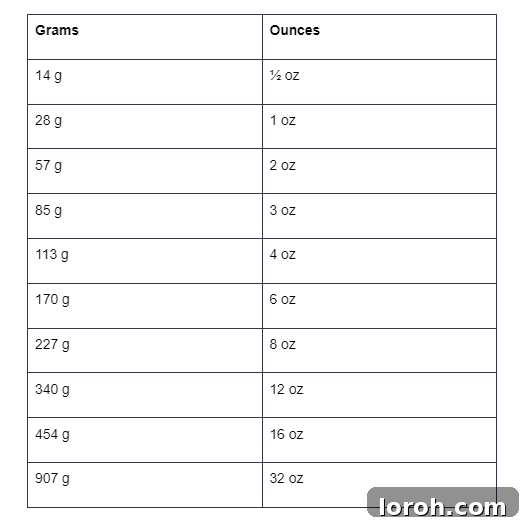
While the calculation is straightforward, having a quick reference can be incredibly helpful when you’re in the middle of preparing a complex dish. Below is a comprehensive table converting common gram measurements to their approximate ounce equivalents, rounded to two decimal places for practical use.
| Grams (g) | Ounces (oz) |
|---|---|
| 1 g | 0.04 oz |
| 5 g | 0.18 oz |
| 10 g | 0.35 oz |
| 15 g | 0.53 oz |
| 20 g | 0.71 oz |
| 25 g | 0.88 oz |
| 28.35 g | 1.00 oz |
| 30 g | 1.06 oz |
| 50 g | 1.76 oz |
| 75 g | 2.65 oz |
| 100 g | 3.53 oz |
| 125 g | 4.41 oz |
| 150 g | 5.29 oz |
| 175 g | 6.17 oz |
| 200 g | 7.05 oz |
| 225 g | 7.94 oz |
| 250 g | 8.82 oz |
| 300 g | 10.58 oz |
| 400 g | 14.11 oz |
| 500 g | 17.64 oz |
| 1000 g (1 kg) | 35.27 oz |
This table serves as a quick reference for many common ingredient quantities you might encounter in recipes. Remember that for critical measurements, especially in baking, using a digital scale set to grams offers the highest degree of accuracy.
Frequently Asked Questions About Grams and Ounces
There are approximately 0.03527396 ounces in a single gram. This means that an ounce is significantly heavier than a gram. To calculate this, you simply take the inverse of our main conversion factor: 1 / 28.35 ≈ 0.0353.
One ounce (oz) weighs approximately 28.35 grams. This is the fundamental conversion rate you’ll use most often when converting from ounces to grams by multiplying, or from grams to ounces by dividing.
One ounce is approximately equal to 28.35 grams. Therefore, 30 grams is slightly more than 1 ounce. Specifically, 30 grams converts to about 1.06 ounces (30 / 28.35 ≈ 1.06).
No, 100 grams is definitely not 1 ounce. One ounce is approximately 28.35 grams. So, 100 grams is significantly more than 1 ounce, equating to roughly 3.53 ounces (100 / 28.35 ≈ 3.53). This illustrates why precise conversion is so important to avoid major discrepancies in your recipes.
Digital kitchen scales, which measure in grams, provide far greater accuracy than measuring cups for dry ingredients like flour, sugar, and oats. The volume of a cup can vary based on how an ingredient is packed (e.g., sifted, spooned, or scooped), leading to inconsistent weight. A scale measures the actual mass, ensuring you always have the exact amount specified, which is critical for consistent baking results.
While both grams and fluid ounces measure quantity, they are distinct: grams measure mass (weight), and fluid ounces measure volume. You cannot directly convert fluid ounces to grams without knowing the density of the liquid. For example, 1 fluid ounce of water weighs approximately 29.57 grams, but 1 fluid ounce of honey would weigh considerably more due to its higher density. Always look for conversions specific to the ingredient you are measuring or use a scale if the recipe provides a gram weight.
The avoirdupois ounce is the common ounce used in cooking and general weight measurements, equaling approximately 28.35 grams. The troy ounce, on the other hand, is a specific unit of measurement used primarily for precious metals like gold and silver. A troy ounce is slightly heavier than an avoirdupois ounce, equaling approximately 31.103 grams. For kitchen purposes, you will always be dealing with the avoirdupois ounce.
Achieving Culinary Confidence: Key Takeaways
Mastering the conversion between ounces and grams is an indispensable skill that will elevate your cooking and baking to new heights. The core principle to remember is that one avoirdupois ounce equals approximately 28.35 grams, and conversely, one gram is about 0.035 ounces. This precise relationship forms the bedrock of accurate measurement in the kitchen.
For unparalleled accuracy, especially when crafting delicate baked goods, embracing the metric system and utilizing a digital kitchen scale is highly recommended. Measuring ingredients by weight in grams minimizes the inconsistencies inherent in volume measurements, leading to more reliable and delicious results. While traditional measuring cups and spoons can still be effective for certain ingredients, their precision can be enhanced by converting to grams and using a scale whenever possible. With the formulas and conversion tables provided in this guide, you now have the tools to confidently tackle any recipe, ensuring perfect proportions and delectable outcomes every time.
Further Exploration: Related Measurement Guides
Deepen your understanding of culinary measurements with our other helpful conversion resources:
- How Many Ounces in a Pound (A Conversion Guide)
- How Many Ounces in a Pint? (Conversion Guide)
- How Many Ounces Are in a Cup? (Dry and Liquid Measurements)
- How Many Ounces Are in a Quart? (Conversion Guide)