
Mastering Liquid Measurements: How Many Cups in a Gallon?
Have you ever found yourself in the middle of a recipe, pausing to wonder, “Exactly how many cups are in a gallon?” You’re not alone! This common culinary conundrum can quickly turn a smooth cooking or baking session into a head-scratching moment. Understanding basic liquid measurement conversions is not just helpful; it’s absolutely essential for achieving consistent, delicious results in all your kitchen endeavors.
From scaling up a refreshing batch of iced tea for a party to precisely measuring ingredients for a delicate cake, knowing these conversions empowers you to tackle any recipe with confidence. In this comprehensive guide, we’ll demystify the relationship between cups and gallons, explore related measurements, and provide practical tips to make you a measurement master. Whether you’re a seasoned home cook or just starting your culinary journey, this resource will be your trusted companion for accurate and effortless kitchen conversions.
Understanding Basic Volume Measurements
Before diving into the core conversion, let’s establish a clear understanding of the fundamental units we’ll be discussing: the cup and the gallon. These units form the backbone of liquid measurements in the United States customary system.
What is a Cup?
A cup is a standard unit of volume measurement widely utilized in cooking and baking, particularly in the United States. In the U.S. customary system, a standard measuring cup is defined as equivalent to 8 fluid ounces. This also translates to approximately 240 milliliters in the metric system.
Measuring cups are versatile tools designed to measure both liquid and dry ingredients accurately. While a liquid measuring cup typically has a spout and clear markings for measurements at eye level, dry measuring cups are designed to be leveled off for precise amounts. They often come in sets, featuring common fractions like 1/4, 1/3, 1/2, and 3/4 cups, enabling you to measure ingredients with precision and consistency in countless recipes.
What is a Gallon?
A gallon represents a larger unit of volume measurement. It is used in both the U.S. customary and the imperial systems of measurement, though their exact volumes differ (which we’ll explore shortly). In the U.S. customary system, one gallon is precisely equal to 128 fluid ounces, or roughly 3.785 liters.
Gallons are commonly used for measuring larger quantities of liquids, such as milk, water, fuel, or paint. Their significant volume makes them practical for bulk purchases and industrial applications, as well as for understanding the capacity of large containers. Understanding the gallon is key to comprehending its relationship with smaller units like cups, quarts, and pints.
Unraveling Gallon Systems: US Customary vs. Imperial
While the term “gallon” is used across different regions, its precise volume can vary, leading to potential confusion. It’s crucial to differentiate between the US customary gallon and the Imperial gallon, as they are not interchangeable.
The US customary gallon is the standard used in the United States and some Caribbean countries. As mentioned, it is defined as 128 fluid ounces, which converts to approximately 3.785 liters. This is the gallon you’ll encounter in virtually all American recipes, product labels, and everyday measurements.
The Imperial gallon, on the other hand, is primarily used in the United Kingdom and some Commonwealth nations. It is a larger unit, defined as 160 fluid ounces, which equates to approximately 4.546 liters. This difference of 32 fluid ounces (or about 0.76 liters) between the two systems is significant and can drastically affect recipe outcomes or calculations if confused.
For the purpose of this guide, and especially when discussing American recipes, we will exclusively refer to the US customary gallon. This is the system where 1 gallon consistently equals 16 cups.
The Crucial Distinction: Liquid Gallons vs. Dry Gallons
In the realm of volume measurements, you might occasionally hear the terms “liquid gallon” and “dry gallon.” While the concept of a dry gallon exists, its practical application in modern cooking is virtually non-existent, especially compared to the ubiquitous liquid gallon.
A liquid gallon is the standard measurement we have been discussing, containing 128 fluid ounces. This is what you use when measuring liquids like water, milk, juice, or oil. Liquid measuring cups are typically clear with a spout, allowing for easy pouring and accurate reading at eye level.
A dry gallon is a historical unit primarily used for measuring dry commodities like grains or fruits. It is technically larger than a liquid gallon, equating to approximately 4.405 liters or around 148.94 fluid ounces. However, this unit is rarely, if ever, used in contemporary cooking or baking recipes. When measuring dry ingredients such as flour, sugar, or rice, modern recipes invariably call for measurements in cups (dry cups), ounces by weight, or grams. Using a dry gallon for cooking would be impractical and likely lead to inaccurate results.
Therefore, for all your recipe needs, always assume the recipe refers to a liquid gallon when a gallon measurement is specified, and use appropriate dry measuring cups for solid ingredients. This distinction is vital for consistent and successful culinary creations.
The Core Conversion: How Many Cups in a Gallon?
Now, let’s get to the heart of the matter. Understanding the exact relationship between cups and gallons is a fundamental skill that simplifies countless kitchen tasks. The straightforward answer is:
There are 16 cups in one US customary gallon.
This conversion factor is invaluable for scaling recipes, whether you’re making a large batch of punch for a party or reducing a soup recipe for a smaller meal. Let’s break down how this conversion works by looking at the intermediary units of measurement:
- 1 Gallon = 4 Quarts
- 1 Quart = 2 Pints
- 1 Pint = 2 Cups
Using this hierarchy, we can easily calculate:
- Since 1 quart has 2 pints, and there are 4 quarts in a gallon, that means 4 quarts x 2 pints/quart = 8 pints in a gallon.
- Since 1 pint has 2 cups, and there are 8 pints in a gallon, that means 8 pints x 2 cups/pint = 16 cups in a gallon.
Knowing this simple chain of conversions—gallon to quart to pint to cup—provides a robust framework for handling almost any liquid measurement challenge in your kitchen. This clarity ensures that your ingredients are always perfectly proportioned, leading to consistently excellent results.
Related Liquid Measurement Conversions
While cups and gallons are key, understanding how they relate to other common units like quarts, pints, and fluid ounces provides a complete picture of the US customary system. These conversions are equally important for adapting recipes and ensuring accuracy.
Cups to Quarts (and Quarts to Cups)
The conversion between cups and quarts is one of the most frequently used in the kitchen. It’s simple:
1 quart equals 4 cups.
This means that each cup represents one-fourth of a quart. To elaborate:
- Since a cup contains 8 fluid ounces, a quart, which is 4 cups, contains 4 x 8 = 32 fluid ounces.
- To convert cups to quarts, you divide the number of cups by 4. For example, 8 cups would be 8 / 4 = 2 quarts.
- To convert quarts to cups, you multiply the number of quarts by 4. For instance, 3 quarts would be 3 x 4 = 12 cups.
This conversion is particularly useful when dealing with recipes that provide measurements in quarts but you only have measuring cups, or vice-versa.
Cups to Pints (and Pints to Cups)
Pints are another common unit, often seen in recipes for beverages or smaller batches of liquids. The relationship between cups and pints is also straightforward:
There are 2 cups in a pint.
Consequently, each cup is equivalent to half of a pint. Here’s how it breaks down:
- Given that a cup is 8 fluid ounces, a pint, being 2 cups, holds 2 x 8 = 16 fluid ounces.
- To convert cups to pints, you divide the number of cups by 2. For example, 6 cups would be 6 / 2 = 3 pints.
- To convert pints to cups, you multiply the number of pints by 2. For instance, 2 pints would be 2 x 2 = 4 cups.
This conversion is very handy when a recipe calls for a pint of an ingredient, and you only have measuring cups available, allowing for seamless substitution without needing a dedicated pint measuring tool.
Fluid Ounces to Cups (and Cups to Fluid Ounces)
Fluid ounces are the smallest standard liquid measurement unit in this system, forming the building blocks for cups, pints, quarts, and gallons:
1 cup equals 8 fluid ounces.
This is a foundational conversion:
- To convert fluid ounces to cups, you divide the number of fluid ounces by 8. For example, 24 fluid ounces would be 24 / 8 = 3 cups.
- To convert cups to fluid ounces, you multiply the number of cups by 8. For instance, 5 cups would be 5 x 8 = 40 fluid ounces.
Understanding the fluid ounce provides the granularity needed for very precise measurements and helps to tie all the larger units together. Always remember that “fluid ounces” are a measure of volume, distinct from “ounces” which can refer to weight.
Your Essential Liquid Measurement Conversion Chart
To make these conversions even easier, here’s a comprehensive chart summarizing the relationships between gallons, quarts, pints, cups, and fluid ounces in the US customary system. Keep this handy in your kitchen for quick reference!
| Unit | Equivalent in Gallons | Equivalent in Quarts | Equivalent in Pints | Equivalent in Cups | Equivalent in Fluid Ounces |
|---|---|---|---|---|---|
| 1 Gallon (gal) | 1 | 4 | 8 | 16 | 128 |
| 1 Quart (qt) | 1/4 | 1 | 2 | 4 | 32 |
| 1 Pint (pt) | 1/8 | 1/2 | 1 | 2 | 16 |
| 1 Cup (c) | 1/16 | 1/4 | 1/2 | 1 | 8 |
| 1 Fluid Ounce (fl oz) | 1/128 | 1/32 | 1/16 | 1/8 | 1 |
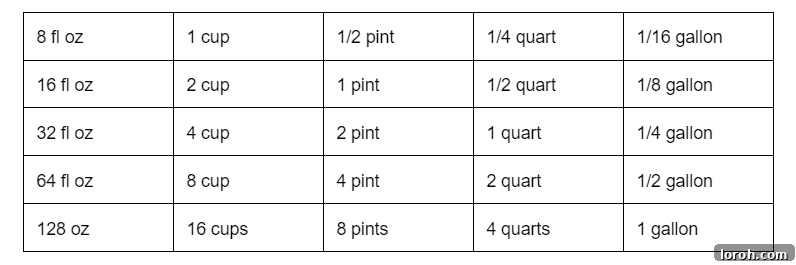
And for a visual aid, here’s another helpful chart:
Practical Tips for Accurate Measurement in the Kitchen
Knowing the conversions is half the battle; the other half is applying them accurately. Here are some indispensable tips to ensure your measurements are always spot-on, leading to consistently perfect results in your cooking and baking:
- Use the Right Tools: Always use liquid measuring cups for liquids and dry measuring cups for dry ingredients. Liquid measuring cups typically have a spout and measurements below the rim, allowing you to fill to the line. Dry measuring cups are designed to be filled to the brim and leveled off.
- Measure Liquids at Eye Level: For precise liquid measurements, place your measuring cup on a flat surface and stoop down so your eyes are level with the measurement line. This eliminates parallax error, where the liquid appears to be at a different level depending on your viewing angle.
- Level Dry Ingredients Properly: When measuring dry ingredients like flour or sugar in a dry measuring cup, fill the cup by spooning the ingredient in (don’t pack it down unless specified, like for brown sugar). Then, use a straight edge, such as the back of a knife or a ruler, to scrape off any excess from the top, ensuring an exact measure.
- Understand Weight vs. Volume: While this guide focuses on volume, remember that for critical baking recipes, measuring by weight (grams or ounces on a kitchen scale) is often far more accurate, especially for ingredients like flour. Volume can vary based on how tightly an ingredient is packed.
- Don’t Confuse Fluid Ounces with Weight Ounces: As discussed, fluid ounces measure volume (how much space a liquid occupies), while standard ounces measure weight (how heavy something is). They are not interchangeable.
- Double-Check Your Conversions: When scaling recipes up or down, or converting between units, it’s easy to make a mental slip. If you’re unsure, refer back to a conversion chart or quickly re-calculate to prevent mistakes.
By following these simple yet crucial tips, you’ll enhance your kitchen precision and elevate the consistency and quality of your culinary creations.
Why Understanding Conversions Elevates Your Cooking
Mastering liquid measurement conversions isn’t just about avoiding a recipe mishap; it fundamentally enhances your capabilities and confidence in the kitchen in several ways:
- Recipe Adaptability: You gain the freedom to easily scale recipes up for larger gatherings or down for smaller portions. Need to make a triple batch of soup? No problem. Want to halve a dessert recipe? You’ve got it.
- International Cooking: Many international recipes use the metric system (liters and milliliters) or the Imperial system. With a solid grasp of conversions, you can confidently translate these measurements into the US customary units you’re familiar with, opening up a world of new culinary experiences.
- Problem Solving: If you’re missing a specific measuring tool (e.g., a quart pitcher), knowing that 1 quart equals 4 cups allows you to improvise and use what you have on hand without compromising accuracy.
- Ingredient Substitution: Understanding volume equivalents can help you make informed substitutions if you’re out of a particular ingredient but have an equivalent in a different unit.
- Reduced Waste: Accurate measurements prevent costly mistakes, ensuring you don’t waste precious ingredients due to incorrect proportions.
- Consistent Results: Precision is the cornerstone of great cooking and especially baking. Knowing your conversions ensures that your favorite dishes turn out perfectly every single time, just as intended.
In essence, becoming proficient in kitchen conversions transforms you from a recipe follower into a more intuitive and capable cook, ready to tackle any culinary challenge with ease and expertise.
Frequently Asked Questions (FAQs)
Here are answers to some of the most common questions about liquid measurement conversions:
- Does 4 cups equal 1 gallon?
- No. In the United States customary system, 1 gallon is equal to 16 cups. Therefore, 4 cups would only be equal to ¼ (one-quarter) of a gallon.
- Is 1 gallon equal to 8 cups?
- No, 1 gallon is not equal to 8 cups. 1 gallon is equivalent to 16 cups. If a recipe calls for a gallon of an ingredient, you need to use 16 cups to meet that measurement.
- How many fl oz cups in a gallon?
- A US customary gallon is equivalent to 128 fluid ounces. Since a standard measuring cup in the US holds 8 fluid ounces, there are 16 cups in a gallon (128 fluid ounces / 8 fluid ounces per cup = 16 cups).
- How many ounces are in a half gallon?
- Since a full gallon contains 128 fluid ounces, a half gallon contains exactly half of that: 64 fluid ounces.
- How many cups are in a half gallon?
- Following the same logic, if a full gallon has 16 cups, then a half gallon contains 8 cups.
- What’s the easiest way to remember these conversions?
- Many people use mnemonic devices. A popular one is drawing a large “G” for gallon, putting four “Q”s (quarts) inside it, two “P”s (pints) inside each “Q”, and two “C”s (cups) inside each “P”. This visual aid quickly shows that 1 G = 4 Q = 8 P = 16 C.
Conclusion: Become a Measurement Master
In conclusion, mastering the conversion between cups and gallons, along with their related units, is a fundamental skill that significantly enhances your capabilities in the kitchen. By understanding that there are precisely 16 cups in one US customary gallon, you unlock the ability to measure ingredients with accuracy, confidently scale recipes up or down, and troubleshoot measurement challenges.
This precision is paramount for ensuring your culinary and baking projects consistently yield delicious and desirable results. Armed with the knowledge from this guide—from distinguishing between US and Imperial gallons to practical measuring tips—you now have the tools to approach any recipe with newfound confidence. Embrace these conversions, and you’ll not only improve your cooking but also enjoy the creative freedom that comes with true kitchen mastery. Happy cooking!
More Helpful Resources
- How Many Ounces in a Pound (A Conversion Guide)
- How Many Ounces in a Pint? (Conversion Guide)
- How Many Ounces Are in a Cup? (Dry and Liquid Measurements)
- How Many Ounces Are in a Quart? (Conversion Guide)