
Ever found yourself mid-recipe, staring blankly at an ingredient list, wondering exactly how many ounces are in a pound? You’re not alone! This common culinary conundrum can quickly turn a simple cooking task into a frustrating guessing game. While online calculators offer a quick fix, understanding the core conversion is invaluable for consistent, successful results in your kitchen.
Precision is key in cooking and especially in baking. An accurate measurement can be the difference between a perfectly risen cake and a dense disaster, or a well-seasoned dish and a bland disappointment. Our comprehensive guide is designed to demystify the ounces-to-pounds conversion, empowering you to measure like a professional with confidence and ease. We’ll cover everything from the basic conversion formulas to practical tips for measuring both dry and wet ingredients, and even delve into the nuances of different measurement systems.
By the end of this guide, you won’t just know the answer to “how many ounces in a pound”; you’ll possess a deeper understanding of weight measurements that will serve you well in all your culinary adventures. Get ready to effortlessly convert, measure, and create delicious masterpieces without a second thought!
Table of Contents
- How Many Ounces in a Pound?
- Pounds to Ounces Conversion Table (Lb to Oz)
- What is an Ounce?
- What is a Pound?
- The Importance of Accurate Measurement
- Converting Ounces to Pounds
- Ounces to Pounds Conversion Chart
- Imperial System vs. Metric System: A Closer Look
- Practical Tips for Measuring Ingredients
- Frequently Asked Questions
- More Helpful Resources
How Many Ounces in a Pound?
Let’s cut straight to the chase: the fundamental conversion you need to remember for weight is simple and consistent across most common contexts:
1 pound (lb) = 16 ounces (oz)
This foundational knowledge is your first step towards mastering kitchen conversions. Whether you’re weighing flour for a cake, meat for a stew, or vegetables for a side dish, this ratio remains constant. The pound and ounce are units of weight from the Imperial and US customary systems, primarily used for dry ingredients and solid items.
To easily convert pounds to ounces, you can use this straightforward formula:
Number of pounds × 16 = Total ounces
For example, if a recipe calls for two pounds of ground beef and you need to know the equivalent in ounces:
- 2 pounds × 16 = 32 ounces
This simple multiplication is your go-to method for converting larger quantities measured in pounds into their ounce equivalents, ensuring you always have the correct amount of ingredient for your dishes.
Pounds to Ounces Conversion Table (Lb to Oz)
For those times when you need a quick reference without doing the math, our pounds to ounces conversion table is an invaluable tool. Keep it handy in your kitchen or bookmark this page for instant access, allowing you to convert quantities at a glance and keep your cooking flow uninterrupted.
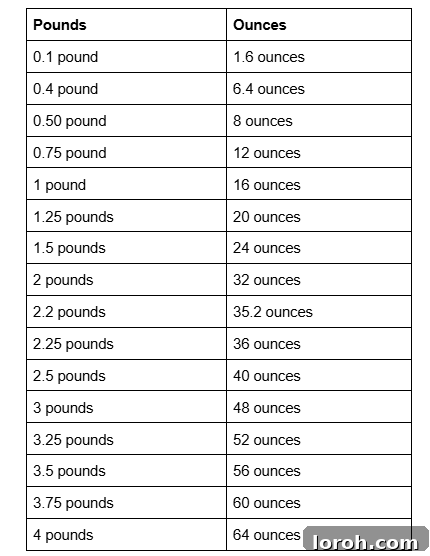
This table makes it incredibly simple to translate common pound measurements into their ounce counterparts. Whether you’re working with a half-pound of butter or several pounds of potatoes, you can quickly find the exact ounce measurement you need.
What is an Ounce?
An ounce (oz) is a unit of measurement that plays a dual role in the kitchen: it can refer to both weight (mass) and volume. Understanding this distinction is crucial, as using a weight ounce when a fluid ounce is needed, or vice-versa, can significantly impact your recipe.
Weight Ounce (Avoirdupois Ounce)
When we talk about “how many ounces in a pound,” we are specifically referring to the avoirdupois ounce. This is a unit of weight or mass, and it’s what you use when a recipe asks for a certain amount of flour, sugar, meat, or any other solid ingredient by weight. The avoirdupois ounce is part of both the Imperial system (used in the UK and some Commonwealth countries) and the US customary system. In this context, 1 pound always equals 16 ounces, globally.
Fluid Ounce (fl oz)
A fluid ounce (fl oz), on the other hand, is a unit of volume, used to measure liquids. This is where things can get a little tricky, as the volume of a fluid ounce differs slightly between the US customary system and the British Imperial system. For example:
- 1 US fluid ounce = approximately 29.57 milliliters
- 1 British Imperial fluid ounce = approximately 28.41 milliliters
While this difference might seem small, it can add up in larger quantities, especially in baking where precise liquid measurements are often critical. Therefore, always pay attention to the origin of your recipe to determine which fluid ounce standard it adheres to. For the purpose of “ounces in a pound,” however, we are focused on weight ounces, which do not have this variation.
What is a Pound?
A pound (lb) is a fundamental unit of weight or mass primarily used in the Imperial and US customary systems of measurement. Historically, the term “pound” has origins in ancient Roman units of weight, with the “avoirdupois pound” being the most common modern iteration used for general commercial and culinary purposes.
In the kitchen, the pound is frequently used for measuring larger quantities of ingredients, such as:
- Large bags of flour or sugar
- Roasts or larger cuts of meat
- Blocks of cheese or butter
- Bulk produce like potatoes or apples
Understanding the pound in relation to other measurement systems is also helpful:
- 1 pound (lb) = 16 ounces (oz)
- 1 pound (lb) = approximately 453.6 grams (g)
- 1 pound (lb) = approximately 0.45359 kilograms (kg)
While the United States uses pounds extensively, it’s also commonly encountered in recipes from the United Kingdom, Canada, and other countries that have historical ties to the British Imperial system. For recipes originating from countries using the metric system, ingredients will typically be listed in grams or kilograms, necessitating a conversion if you’re using a scale calibrated in pounds and ounces.
The Importance of Accurate Measurement
In cooking, and especially in baking, accurate measurement is paramount. While a pinch of this or a dash of that might work for seasoned chefs improvising a savory dish, baking is often a science that relies on precise ratios. Slight deviations in ingredient quantities, particularly dry ingredients like flour or leavening agents, can significantly alter the texture, taste, and overall success of your baked goods.
For instance, adding too many ounces of flour (even just an extra ounce or two) can result in a dry, dense cake, while too little could lead to a crumbly mess. Similarly, when scaling recipes up or down, correctly converting pounds to ounces and vice versa ensures that the proportions remain balanced, preserving the intended flavor profile and consistency.
Relying on accurate conversions, whether you’re using a digital kitchen scale or carefully measured cups, builds confidence in the kitchen. It removes the guesswork and allows you to recreate recipes consistently, achieving the desired outcome every time. Our conversion charts and explanations aim to equip you with this essential precision.
Converting Ounces to Pounds
Once you’ve mastered converting pounds to ounces, let’s explore the inverse: converting ounces to pounds. This conversion is equally useful, especially when you have a specific amount of an ingredient measured in ounces and need to know its equivalent in pounds, perhaps for portion control, budgeting, or to understand a recipe that lists ingredients in pounds.
Since 1 pound equals 16 ounces, to convert ounces back to pounds, you simply divide the number of ounces by 16:
- 1 ounce = 1/16 pound
So, if you have a certain number of ounces, you can determine the number of pounds with this formula:
Number of ounces ÷ 16 = Total pounds
For example, if a recipe calls for 24 ounces of a particular ingredient, and you want to know how many pounds that is:
- 24 ounces ÷ 16 = 1.5 pounds
This conversion is perfect for situations where you might have bought an ingredient by the ounce and need to fit it into a recipe that uses pounds, or vice-versa. It ensures accuracy and helps you manage your ingredients effectively.
Ounces to Pounds Conversion Chart
To further simplify your kitchen tasks, here’s a handy chart for quick conversions from ounces to pounds. This visual aid makes it easy to find the equivalent pound measurement for common ounce quantities, saving you time and effort.
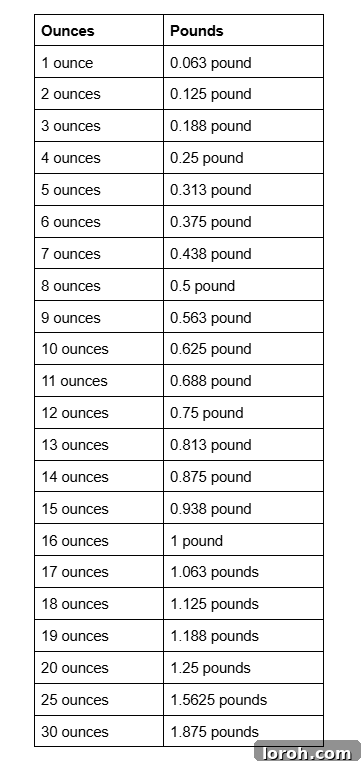
With this chart at your disposal, converting between ounces and pounds becomes a seamless part of your cooking routine, ensuring precision and helping you achieve perfect results with every recipe.
Imperial System vs. Metric System: A Closer Look
Understanding the difference between the Imperial and Metric systems is fundamental for anyone serious about cooking and baking globally. These are the two predominant systems of measurement used worldwide, and confusing them can lead to disastrous culinary outcomes.
The Imperial System
The Imperial system, often referred to as the British Imperial System, is a system of weights and measures that originated in the United Kingdom. It is characterized by units like inches, feet, miles, pounds, ounces, pints, quarts, and gallons. While the UK has largely adopted the metric system for many purposes, Imperial units are still commonly used, especially in daily life and traditional recipes. The United States also uses a system very similar to the Imperial system, known as the US Customary System, which shares many unit names but can have slight differences in volume measurements (like the fluid ounce or cup).
The Metric System
The Metric system, on the other hand, is a decimal-based system of measurement used by most countries around the world. Its base units include the meter for length, the liter for volume, and the gram for mass (weight). The beauty of the metric system lies in its simplicity and logical progression: units are related by powers of ten (e.g., 1,000 grams in a kilogram, 1,000 milliliters in a liter).
Why the Difference Matters in the Kitchen
For weight measurements (like ounces and pounds), the conversion of 1 pound = 16 ounces is consistent between the Imperial and US Customary systems. However, problems arise with volume measurements:
- Fluid Ounces: As mentioned, a US fluid ounce (approx. 29.57 ml) is slightly different from a British Imperial fluid ounce (approx. 28.41 ml).
- Cups and Pints: The volume of a “cup” or “pint” can also vary between systems. A US customary cup is 8 fluid ounces, whereas an Imperial cup is less commonly standardized in the UK, often recipes will use milliliters or grams.
Therefore, it’s absolutely crucial to note which system a recipe is using. If a recipe originates from a US source, assume US customary measurements. If it’s from the UK or an older British cookbook, Imperial units may apply. Recipes from most other countries will likely use the metric system, where grams are the standard for weighing ingredients.
When in doubt, using a digital kitchen scale that can switch between grams, ounces, and pounds is your best friend. This allows you to follow recipes precisely, regardless of their origin, and minimizes the risk of conversion errors affecting your culinary creations.
Practical Tips for Measuring Ingredients
Beyond knowing your conversions, proper measuring techniques are vital for consistency in your cooking and baking. Here are some essential tips:
Using a Kitchen Scale
For dry ingredients like flour, sugar, or oats, a digital kitchen scale is by far the most accurate tool. Weighing ingredients in ounces or grams (rather than measuring by volume with cups) ensures precision because the density of dry ingredients can vary. For example, a cup of flour can weigh differently depending on how it’s scooped or whether it’s sifted. A scale eliminates this variability.
- Tare Function: Always use the tare (zero) function on your scale to weigh only the ingredient, not the bowl.
- Add and Weigh: For multiple ingredients, you can add them one by one, taring the scale after each addition.
Measuring Dry Ingredients by Volume (if a scale isn’t available)
When measuring dry ingredients like flour, sugar, or cocoa powder with measuring cups:
- Spoon and Level Method: Lightly spoon the ingredient into your measuring cup until it overflows, then use a straight edge (like the back of a knife) to level off the excess. Do not pack down flour unless the recipe specifically calls for “packed.”
- For Brown Sugar: Brown sugar is usually packed firmly into the measuring cup to remove air pockets.
Measuring Liquid Ingredients
For liquids like milk, water, oils, or extracts:
- Use Liquid Measuring Cups: These typically have a spout for pouring and clear markings.
- Eye Level: Place the measuring cup on a flat surface and get down to eye level to read the measurement accurately. Do not hold it up in the air, as this can lead to inaccuracies.
Consistency is Key
Once you choose a method for measuring, try to stick with it consistently throughout the recipe and for future uses of that recipe. This helps ensure predictable results every time you cook or bake.
Frequently Asked Questions
Since 1 pound equals 16 ounces, half a pound is 16 ÷ 2 = 8 ounces. So, there are 8 ounces in 0.5 pound.
Regardless of the specific ingredient, 1 pound of any item (including chicken) contains 16 ounces. This is a standard weight conversion.
Similar to chicken, a pound of cheese will always contain 16 ounces. The type of food does not change the weight conversion from pounds to ounces.
This question involves both volume and weight, and the density of the substance matters. For water, 1 US liquid gallon typically weighs about 8.34 pounds (or approximately 6.8 pounds for a UK Imperial gallon, which is a larger volume). The original answer of 6.8 pounds appears to refer to the weight of an Imperial gallon of water.
Yes, absolutely! 16 fluid ounces is equivalent to 1 pound when referring to weight (avoirdupois) ounces. This is the core conversion ratio.
An ounce of weight (avoirdupois ounce) measures mass, used for solid ingredients like flour or meat, where 1 lb = 16 oz. A fluid ounce (fl oz) measures volume, used for liquids like milk or water. These are not interchangeable, as their relationship depends on the density of the substance. For example, 16 fluid ounces of water weighs approximately 1 pound, but 16 fluid ounces of honey would weigh more.
Always use a kitchen scale for baking recipes that specify ingredients by weight (ounces or grams), especially for dry ingredients like flour, sugar, and cocoa powder. A scale provides far more accuracy and consistency than volume measurements (cups), which can vary widely depending on how ingredients are packed or scooped. For general cooking, cups can be sufficient, but a scale is always preferred for precision.
More Helpful Resources for Kitchen Conversions
Expand your culinary knowledge and master even more essential kitchen conversions with these helpful guides:
- How Many Tablespoons Are in a Cup? (A Conversion Guide)
- Melting Chocolate: A Guide
- Baking Powder Vs. Bicarbonate of Soda
- How to Turn Plain Flour Into Self-Raising Flour
Related Kitchen Conversion Guides
Helpful Tips
How Many Tablespoons Are in a Cup? (Conversion Guide)
Helpful Tips
How Many Ounces Are in a Quart? (Conversion Guide)
Helpful Tips
How Many Cups in a Quart? (Conversion Guide)
Helpful Tips
How Many Pints in a Quart? (Conversion Guide)