

Unlock the secrets of weight conversion! Learn how many ounces in a kilogram, master essential conversion guides, and discover practical measuring tips for seamless success in all your culinary adventures and everyday tasks.
Ever found yourself in the middle of a delicate baking recipe, or perhaps deciphering international ingredient lists, only to be stumped by a crucial measurement conversion like figuring out how many ounces are truly in a kilogram? You’re not alone! Navigating different systems of measurement can be a common hurdle, but this comprehensive guide is precisely what you need to overcome it with confidence and precision.

We’re diving deep into everything you need to know about converting ounces to kilograms and vice versa. From understanding the fundamental definitions of each unit to practical conversion formulas and a clear comparison of metric and imperial systems, we’ll equip you with all the knowledge. By the time you reach the end, you’ll be able to measure and convert like a seasoned professional, ensuring flawless execution of your favorite recipes and accurate measurements in any scenario.
Table of Contents
- How Many Ounces in a Kilogram?
- Kilogram to Ounce Conversion Table
- What is an Ounce?
- What is a Kilogram?
- Converting Ounces to Kilograms
- Converting Kilograms to Ounces
- Systems of Measurement: Imperial vs. Metric
- Frequently Asked Questions
- More Helpful Resources
How Many Ounces in a Kilogram?
When dealing with international recipes or scientific data, the question of converting between ounces and kilograms arises frequently. These are two distinct units of mass (often referred to as weight in everyday language) used in different measurement systems. To clarify this common conversion, let’s break down the exact relationship between them.
The standard conversion factor states that one kilogram (kg) contains approximately 35.27396 ounces (oz). For most practical purposes, especially in cooking and general household use, this is often rounded to 35.27 ounces per kilogram.
To understand how this number is derived, it’s helpful to know their relationship to grams, which is the base unit of mass in the metric system:
- One ounce (oz) is precisely equivalent to 28.349523125 grams.
- One kilogram (kg) is exactly equal to 1,000 grams.
Therefore, to find out how many ounces are in one kilogram, you divide the total grams in a kilogram by the number of grams in an ounce:
Number of ounces in 1 kg = Grams in 1 kg ÷ Grams in 1 oz
Number of ounces in 1 kg = 1,000 g ÷ 28.349523125 g/oz
Number of ounces in 1 kg ≈ 35.27396 oz
So, to reiterate, there are roughly 35.27 ounces in a single kilogram. This precise understanding is essential for achieving accuracy in your measurements, whether you’re a professional chef, a home baker, or simply converting weights for everyday tasks.
Kilogram to Ounce Conversion Table
For quick reference and to avoid constant recalculations, a conversion table can be incredibly useful. Below is a table illustrating common kilogram values and their approximate equivalents in ounces. This can be particularly handy in the kitchen or when planning international shipments.
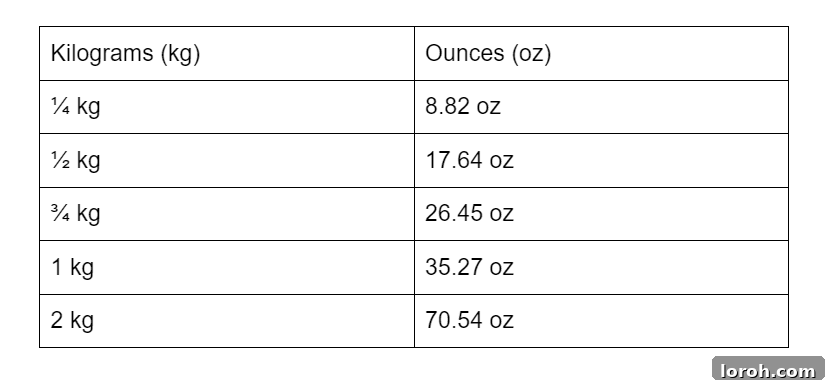
This table provides a quick visual reference, but remember that for extremely precise applications, using the full conversion factor (35.27396) or an online calculator is always recommended.
What is an Ounce?
An ounce (oz) is a versatile unit of measurement that typically refers to weight or mass. It’s a fundamental component of the imperial system of measurement, which is predominantly used in the United States, alongside a few other countries. While we commonly refer to ounces for weight, it’s important to distinguish between different types of ounces:
- Avoirdupois Ounce (Weight): This is the most common type you’ll encounter in daily life, especially in cooking and grocery shopping. One avoirdupois ounce is defined as 1/16th of a pound and is equal to approximately 28.35 grams. When a recipe calls for “ounces” for dry ingredients like flour or sugar, it’s referring to avoirdupois ounces.
- Fluid Ounce (Volume): Abbreviated as “fl oz,” a fluid ounce measures volume, not weight. It is used for liquids like water, milk, or oil. It’s crucial not to confuse fluid ounces with avoirdupois ounces, as their conversions to other units are entirely different, and the weight of a fluid ounce varies depending on the density of the liquid.
- Troy Ounce (Precious Metals): Less common in general use, the troy ounce is exclusively used for measuring the mass of precious metals like gold, silver, and platinum. A troy ounce is slightly heavier than an avoirdupois ounce, weighing approximately 31.10 grams.
For the purpose of converting to kilograms, we are almost always referring to the avoirdupois ounce, which measures mass. The ounce’s smaller unit size makes it ideal for measuring relatively small amounts of ingredients accurately without resorting to decimals in pounds. Its historical roots date back centuries, with various definitions evolving until the standardization used today.
What is a Kilogram?
A kilogram (kg) is the fundamental unit of mass in the International System of Units (SI), which is the modern form of the metric system. It is one of the seven base units of the SI, and its importance is globally recognized across scientific, industrial, and everyday applications.
The term “kilo” is often used as a shortened, informal way to refer to a kilogram. Its symbol, “kg,” is universally understood. Historically, the kilogram was defined by a physical prototype, the International Prototype Kilogram (IPK), a platinum-iridium cylinder. However, as of May 2019, the kilogram’s definition was redefined based on fundamental physical constants, specifically Planck’s constant. This move ensures greater stability and precision in its definition, making it independent of any physical object.
- Base Unit of Mass: The kilogram measures mass, which is a fundamental property of matter indicating its resistance to acceleration (inertia). While often used interchangeably with “weight” in common language, weight is actually the force exerted on a mass due to gravity, and it can vary with location. Mass, however, remains constant.
- Relationship to Grams: The prefix “kilo-” means one thousand, so one kilogram equates to exactly 1,000 grams. This base-ten relationship makes conversions within the metric system incredibly straightforward, a key advantage of the system.
- Everyday Applications: Kilograms are widely used worldwide for measuring various items, from groceries and body weight to shipping parcels, chemical ingredients, and scientific experiments. For example, a bag of sugar might be 1 kg, or a person’s weight might be measured in kilograms in most countries.
- Conversion to Pounds: For those accustomed to the imperial system, it’s useful to remember that one kilogram equates to approximately 2.20462 pounds.
The global adoption of the kilogram, driven by its scientific rigor, ease of use, and coherent structure, makes understanding its conversions crucial for anyone interacting with international standards or scientific data.
Converting Ounces to Kilograms
Converting ounces to kilograms is a common task, especially when adapting recipes from imperial to metric measurements or when dealing with international product specifications. The key to this conversion lies in understanding the precise relationship between the two units.
As established earlier, 1 ounce is equivalent to approximately 0.0283495 kilograms. Therefore, to convert a given number of ounces into kilograms, you simply multiply the number of ounces by this conversion factor. For most practical applications, rounding this factor to 0.02835 kilograms per ounce is sufficiently accurate.
The Conversion Formula:
Number of kilograms = Number of ounces × 0.02835
Let’s walk through a few examples to solidify your understanding:
Example 1: Convert 4 ounces to kilograms
- You have 4 ounces of an ingredient and need to know its weight in kilograms.
- Apply the formula: Number of kilograms = 4 oz × 0.02835 kg/oz
- Calculation: 4 × 0.02835 = 0.1134
- Result: So, there are approximately 0.1134 kilograms in 4 ounces.
Example 2: Convert 12 ounces to kilograms
- Imagine a recipe calls for 12 ounces of chocolate chips.
- Apply the formula: Number of kilograms = 12 oz × 0.02835 kg/oz
- Calculation: 12 × 0.02835 = 0.3402
- Result: 12 ounces is equivalent to approximately 0.3402 kilograms.
Example 3: Convert 35 ounces to kilograms
- If you’re shipping a package weighing 35 ounces.
- Apply the formula: Number of kilograms = 35 oz × 0.02835 kg/oz
- Calculation: 35 × 0.02835 = 0.99225
- Result: 35 ounces is approximately 0.99225 kilograms, which is very close to 1 kilogram.
When performing these conversions, especially in critical applications, it’s wise to consider the level of precision required. For everyday cooking, rounding to two or three decimal places is usually fine. For scientific or industrial uses, maintaining more decimal places from the exact conversion factor (0.028349523125) might be necessary.
Converting Kilograms to Ounces
Just as important as converting ounces to kilograms is the reverse process: converting kilograms to ounces. This conversion is frequently needed when working with metric recipes or product weights and needing to adapt them for tools or instructions that use imperial units, especially in countries like the United States.
To convert a given number of kilograms into ounces, you essentially perform the inverse operation. Instead of multiplying by the “kilograms per ounce” factor, you divide by it. Alternatively, you can multiply by the “ounces per kilogram” factor, which is approximately 35.27396.
The Conversion Formula (Method 1: Division):
Number of ounces = Number of kilograms ÷ 0.02835
The Conversion Formula (Method 2: Multiplication):
Number of ounces = Number of kilograms × 35.27396
Let’s use the division method for our examples, as it directly reverses the previous calculation and reinforces the core conversion factor.
Example 1: Convert 5 kilograms to ounces
- You have 5 kg of flour and want to know its equivalent in ounces for an American recipe.
- Apply the formula: Number of ounces = 5 kg ÷ 0.02835 kg/oz
- Calculation: 5 ÷ 0.02835 ≈ 176.3717
- Result: So, there are approximately 176.37 ounces in 5 kilograms.
Example 2: Convert 0.5 kilograms to ounces
- Suppose you bought a 0.5 kg block of cheese.
- Apply the formula: Number of ounces = 0.5 kg ÷ 0.02835 kg/oz
- Calculation: 0.5 ÷ 0.02835 ≈ 17.637
- Result: 0.5 kilograms is approximately 17.64 ounces.
Example 3: Convert 2.5 kilograms to ounces
- For a larger batch of ingredients, say 2.5 kg of potatoes.
- Apply the formula: Number of ounces = 2.5 kg ÷ 0.02835 kg/oz
- Calculation: 2.5 ÷ 0.02835 ≈ 88.185
- Result: 2.5 kilograms is approximately 88.19 ounces.
Remember that rounding can introduce minor discrepancies, especially over multiple conversions. For the highest accuracy, especially in scientific or commercial contexts, using the full conversion factor (0.028349523125) or an electronic calculator designed for precise conversions is always the best approach. However, for most everyday purposes, the rounded factors provided here will yield perfectly acceptable results.
Systems of Measurement: Imperial vs. Metric
Understanding the fundamental differences between the metric and imperial systems is paramount for anyone navigating global recipes, scientific data, or international trade. These two systems offer distinct approaches to measuring length, weight (mass), volume, and temperature, leading to common conversion challenges.
The Metric System, officially known as the International System of Units (SI), is the most widely adopted system globally. It’s built on a logical, base-ten structure, meaning conversions between units are simple multiples or divisions of 10, 100, 1000, and so forth. This inherent simplicity makes calculations straightforward and reduces the likelihood of errors.
Common metric units include:
- Mass/Weight: Grams (g), Kilograms (kg), Milligrams (mg)
- Volume: Liters (L), Milliliters (mL)
- Length: Meters (m), Centimeters (cm), Kilometers (km)
- Temperature: Degrees Celsius (°C)
Its coherence and ease of use have made it the standard in scientific research, engineering, and international commerce, fostering universal understanding and consistency.
On the other hand, the Imperial System, also known as the British Imperial System, is primarily used in the United States, and to a lesser extent in a few other countries (e.g., Liberia, Myanmar). It evolved from older English units and has less systematic relationships between its units, often relying on historical conventions rather than powers of ten.
Common imperial units include:
- Mass/Weight: Ounces (oz), Pounds (lb), Stones (st), Tons (ton)
- Volume: Fluid ounces (fl oz), Cups (c), Pints (pt), Quarts (qt), Gallons (gal)
- Length: Inches (in), Feet (ft), Yards (yd), Miles (mi)
- Temperature: Degrees Fahrenheit (°F)
Key Differences Summarized:
- Base Units & Conversion: The metric system’s decimal base (powers of ten) makes conversions like grams to kilograms (divide by 1000) incredibly easy. The imperial system’s conversions are more irregular (e.g., 16 ounces in a pound, 12 inches in a foot, 3 feet in a yard, 5,280 feet in a mile).
- Global Adoption: Metric is the international standard, facilitating global communication and trade. Imperial is largely confined to the U.S., which can complicate international collaborations and understanding.
- Unit Names: Metric units often use prefixes (kilo-, milli-, centi-) that clearly indicate their relationship to the base unit. Imperial unit names are often distinct and do not easily indicate numerical relationships (e.g., ounce, pound, stone).
- Clarity and Simplicity: The metric system’s logical structure often leads to fewer calculation errors and easier learning, especially for schoolchildren. The imperial system can be perceived as more intuitive in some everyday contexts due to long-standing cultural familiarity, but it demands memorization of more conversion factors.
Both systems have historical significance and current applications. However, the metric system’s inherent simplicity, global consistency, and scientific precision have made it the dominant force in modern contexts. For those working across borders or disciplines, mastering the conversions between these two systems is an indispensable skill.
Frequently Asked Questions
One kilogram (kg) is equivalent to approximately 35.27396 ounces (oz). For most general purposes, this can be rounded to 35.27 ounces. This means that if you have an item weighing 1 kg, it would weigh just over 35 and a quarter ounces.
To convert 8 ounces to kilograms, you multiply 8 by the conversion factor of 0.0283495. So, 8 oz × 0.0283495 kg/oz = 0.226796 kg. Therefore, 8 ounces is approximately 0.227 kilograms when rounded to three decimal places.
Absolutely, 1 kilogram is significantly more than 3 ounces. As we’ve learned, 1 kilogram is approximately 35.27 ounces. This means 1 kilogram is over 11 times heavier than 3 ounces. For instance, a 1 kg bag of sugar would be much heavier than a small 3-ounce packet of seasoning.
A kilo (short for kilogram) is approximately 35.27 ounces. This precise conversion factor (35.27396) is crucial for accurate measurement, especially when converting between international recipes or working with scientific data.
Different measurement systems like imperial and metric evolved independently over centuries due to various cultural, historical, and practical reasons. The imperial system (derived from older British units) was widely adopted during the British Empire’s expansion, while the metric system (based on decimal units) gained popularity during the French Revolution for its logical and universal design. Today, most countries use the metric system, while the United States remains a primary user of the imperial system.
You should use ounces when following recipes or instructions from countries that primarily use the imperial system, such as the United States. Kilograms should be used when following metric recipes, scientific instructions, or when weighing items for international shipping, as it is the standard unit of mass in most of the world. Always match your units to the source of your information or the requirements of your task for accuracy.
More Helpful Resources
Beyond converting ounces and kilograms, mastering other kitchen and general measurement conversions can greatly enhance your culinary skills and efficiency. Explore these additional helpful guides:
- How Many Tablespoons Are in a Cup? (Conversion Guide)
- Baking Powder Vs Bicarbonate Of Soda
- How To Turn Plain Flour Into Self-raising Flour
- What Kind Of Oil Should I Use?
Helpful Tips
How Many Ounces in a Pound? (Conversion Guide)
Helpful Tips
How Many Grams in an Ounce? (Conversion Guide)
Helpful Tips
How Many Ounces in a Liter? (Conversion Guide)
Helpful Tips