
Unlock the secrets of kitchen measurements with our comprehensive guide! Learn precisely how many pints are in a quart and master essential liquid conversions to ensure culinary success every time.
Ever found yourself staring at a recipe, spoon in hand, wondering, “Exactly how many pints are in a quart?” You’re certainly not alone. Navigating the world of kitchen conversions, especially when dealing with recipes from different regions, can feel like a puzzle. But fear not! Understanding these fundamental relationships is a game-changer, helping you save time, prevent common cooking mishaps, and confidently tackle any recipe, whether it’s a family heirloom or an international delicacy.
This in-depth guide is designed to be your ultimate resource. We’ll not only provide the straightforward answer to “how many pints in a quart” but also delve into the nuanced differences between US Customary and UK Imperial measurements. You’ll find easy-to-use conversion charts, practical tips for accurate measuring, a historical overview of these units, and answers to all your frequently asked questions. By the end, you’ll be a measurement maestro, ready to conquer any culinary challenge!
Table of Contents
- How Many Pints in a Quart? Understanding US vs. UK Systems
- Quick Conversion Table: Pints to Quarts (US Customary Measurements)
- What Exactly is a Pint?
- Decoding the Quart: A Closer Look
- The Grand Picture: Pints, Quarts, Cups, Gallons, and Ounces
- Why Accurate Measurement is Non-Negotiable in the Kitchen
- Pro Tips for Flawless Kitchen Conversions
- Common Kitchen Conversions at a Glance
- Frequently Asked Questions About Pints and Quarts
- Conclusion: Confident Cooking Through Accurate Conversions
How Many Pints in a Quart? Understanding US vs. UK Systems
The straightforward answer to this common query largely depends on where you are in the world. Measurement systems, particularly for liquids, can vary significantly between countries. Let’s break down the conversion for the two most common systems:
In the United States Customary System:
For most home cooks and bakers in the United States, the conversion is simple and consistent:
- There are exactly 2 pints in 1 quart.
This means if your recipe calls for 1 quart of chicken stock, you’ll need 2 pints. Conversely, if you have 3 pints of milk, that’s equivalent to 1.5 quarts. This relationship is foundational for understanding other liquid volume conversions within the US system, as we’ll explore shortly.
In the United Kingdom Imperial System:
Things get a little more nuanced when you cross the Atlantic. While the *ratio* of pints to quarts remains the same, the *size* of the units differs:
- 1 UK quart also equals 2 UK pints.
However, and this is crucial, UK pints are larger than US pints. This size difference stems from the varying definitions of a fluid ounce in each system. A UK (Imperial) pint contains 20 fluid ounces, whereas a US pint contains 16 fluid ounces. Consequently, a UK quart is also larger than a US quart.
To put it into perspective:
- 1 US pint = 16 US fluid ounces
- 1 UK pint = 20 Imperial fluid ounces
- 1 US quart = 32 US fluid ounces
- 1 UK quart = 40 Imperial fluid ounces
This distinction is incredibly important, especially when following international recipes. A “quart” in a British cookbook will contain more liquid than a “quart” in an American cookbook. Always double-check the origin of your recipe or clarify the measurement system being used to avoid unexpected results!
Quick Conversion Table: Pints to Quarts (US Customary Measurements)
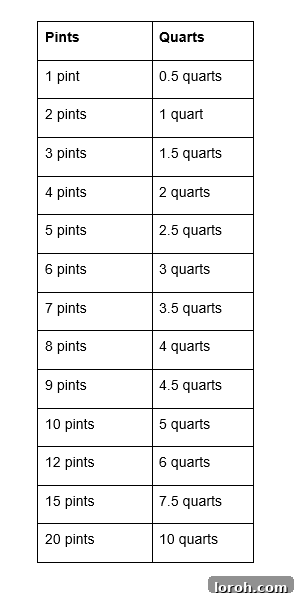
To make your life easier in the kitchen, here’s a handy reference table specifically for US customary measurements, showing common conversions between pints and quarts:
| Pints (pt) | Quarts (qt) |
|---|---|
| 1 pint | 0.5 quarts |
| 2 pints | 1 quart |
| 3 pints | 1.5 quarts |
| 4 pints | 2 quarts |
| 5 pints | 2.5 quarts |
| 6 pints | 3 quarts |
| 8 pints | 4 quarts (1 gallon) |
Remember, to convert pints to quarts, you simply divide the number of pints by 2. To convert quarts to pints, multiply the number of quarts by 2. It’s that simple for US measurements!
What Exactly is a Pint?
The term “pint” (abbreviated as ‘pt’) is a unit of volume measurement steeped in history, primarily used in both the imperial and U.S. customary systems. Its origins can be traced back to the French word ‘pinte’, and it has historically been used to measure a variety of liquids.
- In the U.S. Customary System: A US pint is equivalent to 16 fluid ounces, or half a US quart. It’s commonly used for measuring beverages like milk, craft beer, and often for smaller quantities of liquid ingredients in recipes.
- In the Imperial System (primarily the UK): An Imperial pint is significantly larger, equating to 20 Imperial fluid ounces. This difference means a pint of milk or beer in the UK contains more liquid than its US counterpart.
While most commonly associated with liquids, pints can also, less frequently, be used to measure certain dry ingredients in older or very specific recipes. However, for accuracy, especially in baking, weighing dry ingredients is always preferred.
Decoding the Quart: A Closer Look
A “quart” (abbreviated as ‘qt’) is another fundamental unit of liquid measurement. The word “quart” itself gives a clue to its origin, deriving from the Latin word ‘Quartus’ and the Old French ‘Quarte’, both meaning “a fourth portion.” This indicates its historical relationship to larger units, specifically a gallon.
- In the United States Customary System: A US quart is precisely equivalent to 2 US pints or 4 US cups, and it constitutes one-fourth (1/4) of a US gallon. This makes it a convenient unit for medium-sized quantities of liquids like broth, sauces, or large batches of iced tea. It measures 32 US fluid ounces.
- In the Imperial System: An Imperial quart is correspondingly larger than its US counterpart, measuring approximately 40 Imperial fluid ounces. Like the Imperial pint, it also represents one-fourth of an Imperial gallon, but the overall volume is greater.
Quarts are frequently seen in recipes for soups, stews, and when buying certain dairy products or juices. Understanding its relationship to both pints and gallons is key to fluidly navigating larger recipe requirements.
The Grand Picture: Pints, Quarts, Cups, Gallons, and Ounces
To truly master liquid measurements, it helps to see how pints and quarts fit into the broader system of cups, gallons, and fluid ounces. This hierarchy is essential for scaling recipes and understanding ingredient lists more deeply.
US Customary System Hierarchy:
- Fluid Ounces (fl oz): The smallest common unit of liquid volume.
- Cups (c): 8 fluid ounces make 1 cup.
- Pints (pt): 2 cups (16 fluid ounces) make 1 pint.
- Quarts (qt): 2 pints (4 cups, 32 fluid ounces) make 1 quart.
- Gallons (gal): 4 quarts (8 pints, 16 cups, 128 fluid ounces) make 1 gallon.
This “Gallon Man” (or “Gallon Robot”) concept, often taught in schools, provides a memorable visual aid: a gallon has 4 quarts, each quart has 2 pints, and each pint has 2 cups. Grasping these relationships can make conversions between any of these units effortless.
Imperial System Hierarchy (UK):
While the relationships between pints, quarts, and gallons are the same (2 pints to a quart, 4 quarts to a gallon), the underlying fluid ounce volume is different:
- Imperial Fluid Ounces: Distinct from US fluid ounces.
- Cups: While “cups” are used in some British recipes, their volume isn’t as standardized as in the US, often relying on metric (milliliters) or weight-based measurements. However, an Imperial pint is 20 fl oz.
- Imperial Pints (pt): 20 Imperial fluid ounces.
- Imperial Quarts (qt): 2 Imperial pints (40 Imperial fluid ounces).
- Imperial Gallons (gal): 4 Imperial quarts (8 Imperial pints, 160 Imperial fluid ounces).
Understanding these distinct systems prevents costly mistakes and ensures your culinary creations turn out perfectly, regardless of the recipe’s origin.
Why Accurate Measurement is Non-Negotiable in the Kitchen
While some dishes might be forgiving, many others demand precision. Measuring liquid ingredients accurately can truly make or break a dish, especially in the delicate science of baking, where chemical reactions depend on exact ratios. A seemingly small difference of even a few fluid ounces can drastically alter the consistency, texture, flavor, and even cooking time of your culinary masterpiece.
Consider these scenarios:
- Baking: Too much liquid can result in a soggy cake or dense bread, while too little can lead to dry, crumbly results. The precise balance of wet and dry ingredients is key to achieving the desired structure and rise.
- Sauces and Soups: An extra pint of broth can dilute a rich sauce, making it thin and flavorless. Conversely, insufficient liquid can make a soup too thick or overly concentrated.
- International Recipes: This is where the US vs. UK measurement difference becomes a critical point of concern. If you’re using a cherished family recipe from a British relative or trying out a new dish from an Australian cookbook, a “pint” or “quart” might mean something entirely different than what your US measuring cup suggests. Failing to convert correctly can lead to disastrous culinary outcomes – imagine a perfectly balanced curry becoming too watery or a delicate custard turning into a solid block.
- Cost and Waste: Inaccurate measurements can lead to wasted ingredients, especially when dealing with expensive items like specialty oils, wines, or dairy. Getting it right the first time saves both your ingredients and your budget.
Investing a little time to understand and apply correct conversions will elevate your cooking from guesswork to gourmet.
Pro Tips for Flawless Kitchen Conversions
Navigating different measurement systems doesn’t have to be daunting. Here are some actionable tips to ensure your kitchen conversions are always spot-on:
- Always Look for Unit Clarification: The first and most important step. Many international recipes will specify “US quart,” “Imperial pint,” “metric milliliters,” or “grams.” If it’s not specified, a quick search for the recipe’s origin can often clarify which system is in use.
- Keep a Reliable Conversion Calculator or Chart Handy: There are numerous apps for smartphones, websites, and printable charts available. Laminate a chart and stick it to your fridge or inside a cabinet door for quick reference. When in doubt, verify the conversion.
- Invest in Versatile Measuring Tools: Purchase a high-quality measuring jug that features both metric (milliliters, liters) and imperial (cups, pints, quarts, fluid ounces) units. This eliminates the need for mental math or external charts for common conversions. Look for clear markings and durable materials.
- Embrace the Metric System for Precision: For the most precise and universally consistent way to cook or bake, especially when dealing with international recipes, consider weighing ingredients in grams. Because grams measure mass, they remain consistent regardless of density, how ingredients are packed, chopped, or scooped—unlike volume-based measurements, which can vary significantly depending on technique and ingredient type (e.g., packed flour vs. sifted flour). Many professional chefs and bakers worldwide rely on scales for this exact reason.
- When in Doubt, Round Up (Slightly) or Down: If a recipe calls for a very precise measurement that’s hard to achieve with your tools, it’s often better to slightly under-measure or over-measure depending on the ingredient. For example, a little extra liquid in a soup is usually easier to correct than too little. Use your best judgment based on the ingredient’s role in the dish.
- Practice Makes Perfect: The more you cook and experiment with different recipes and conversions, the more intuitive these measurements will become. Don’t be afraid to try new things!
Common Kitchen Conversions at a Glance
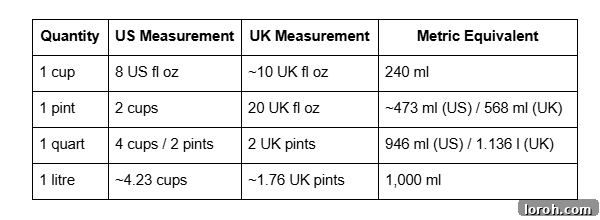
Beyond pints and quarts, having a general understanding of how various liquid units relate to each other is incredibly useful. Here’s a quick chart to help you convert between pints, quarts, cups, and liters for US measurements:
| Unit | Equivalent in US Customary | Approx. Metric Equivalent |
|---|---|---|
| 1 cup | 8 fluid ounces | 240 ml |
| 1 pint | 2 cups (16 fl oz) | 473 ml (approx. 0.47 liters) |
| 1 quart | 2 pints (4 cups, 32 fl oz) | 946 ml (approx. 0.95 liters) |
| 1 gallon | 4 quarts (8 pints, 16 cups, 128 fl oz) | 3.785 liters |
| 1 liter | Approx. 1.057 quarts | 1000 ml |
| 1 fluid ounce | 2 tablespoons | 30 ml |
This table provides a comprehensive overview, making it easier to jump between different units as your recipe demands. Note that metric conversions are approximations for convenience in most cooking scenarios.
Frequently Asked Questions About Pints and Quarts
Yes, absolutely! One quart is exactly equal to two pints, whether you are referring to the US customary measurement system or the UK imperial measurement system. So, a quart holds twice the volume of a pint.
No, they are not the same size. A UK (Imperial) pint is larger, containing 20 fluid ounces, while a US pint contains only 16 fluid ounces. This difference is critical for accurate conversions, especially when following recipes from different countries.
This is a common point of confusion! Fluid ounces (fl oz) are a measure of volume, used for liquids. Ounces (oz), on the other hand, typically measure weight or mass, used for dry ingredients like flour, sugar, or meat. While 8 fluid ounces of water weighs approximately 8 ounces, this weight equivalence does not hold true for other ingredients like flour or feathers. Always pay attention to whether “oz” or “fl oz” is specified.
There are 4 cups in 1 US quart. Since a pint contains 2 cups, and a quart contains 2 pints, this works out to 2 pints * 2 cups/pint = 4 cups/quart.
There are 4 quarts in 1 US gallon. The word “quart” itself implies “a fourth,” reinforcing its relationship to a gallon.
There are 8 American pints in 1 US gallon. Since 1 gallon has 4 quarts, and each quart has 2 pints, the calculation is 4 quarts * 2 pints/quart = 8 pints/gallon.
To convert US to UK measurements, you generally need to account for the difference in fluid ounces. For example, 1 US pint (16 fl oz) is approximately 0.83 Imperial pints (16/20). Similarly, 1 US quart (32 fl oz) is about 0.83 Imperial quarts (32/40). For reverse conversion, 1 Imperial pint (20 fl oz) is 1.25 US pints (20/16). It’s always best to use an online converter or a detailed chart for precise conversions.
Yes, a liter is slightly larger than a US quart. A US quart is approximately 0.946 liters, while a liter is about 1.057 US quarts. The liter is part of the metric system and is a globally recognized standard for volume.
Conclusion: Confident Cooking Through Accurate Conversions
Understanding how many pints are in a quart, and indeed mastering other essential kitchen conversions, is far from a trivial detail—it’s a foundational skill for any home cook or aspiring chef. This knowledge transforms cooking from a series of educated guesses into a precise and predictable art form, significantly improving your success rate in the kitchen.
Whether you’re doubling a family-sized soup recipe, halving a dessert for a smaller gathering, or venturing into the exciting world of international cuisine, having a firm grasp of these measurement relationships will keep your cooking stress-free, delicious, and consistently perfect. Embrace the power of accurate measurement, and unlock a new level of confidence and creativity in your culinary endeavors!
Helpful Tips
How Many Ounces Are in a Cup? (Dry and Liquid Measurements)
Helpful Tips
How Many Cups in a Quart? (Conversion Guide)
Helpful Tips
How Many Ounces in a Pint? (Conversion Guide)
Helpful Tips