
Unlock the secrets to perfect measurements in the kitchen with our definitive guide on how many ounces are in a pint! Whether you’re a seasoned chef or a home cooking enthusiast, understanding these fundamental conversions is key to culinary success. We’ll demystify liquid and dry ingredient measurements, ensuring you can convert and measure with absolute confidence.
Have you ever found yourself in the middle of a recipe, staring blankly at an ingredient list, unsure of the exact ounces in a pint? The frustration is real, and while online calculators offer a quick fix, they aren’t always accurate or easy to navigate when your hands are covered in flour. Our aim is to simplify this essential conversion process, providing you with the knowledge and tools to succeed with every dish you create.
This comprehensive guide delves into everything you need to know about converting ounces to pints accurately, covering both U.S. customary and Imperial systems. We also provide invaluable tips for measuring both dry and wet ingredients effectively. By the time you finish reading, you’ll be effortlessly converting units and measuring ingredients like a professional, elevating your cooking and baking game.
Table of Contents
- The Core Question: How Many Ounces in a Pint?
- Understanding the Ounce: A Versatile Unit
- Demystifying the Pint: A Measure of Volume
- Fluid Ounces vs. Dry Ounces: The Critical Distinction
- Navigating Measurement Systems: US, Imperial, and Metric
- Pints in Practice: Liquid vs. Dry Volume Clarified
- Tips for Accurate Measurement in the Kitchen
- Why Precision Matters: The Impact on Your Recipes
- Frequently Asked Questions
- More Helpful Resources
The Core Question: How Many Ounces in a Pint?
Let’s get straight to the answer you’re looking for. The exact number of ounces in a pint depends crucially on the measurement system you are using:
- In the U.S. Customary System, a standard liquid pint contains 16 fluid ounces (fl oz).
- In the Imperial System, commonly used in the United Kingdom and some Commonwealth countries, a liquid pint contains 20 fluid ounces (fl oz).
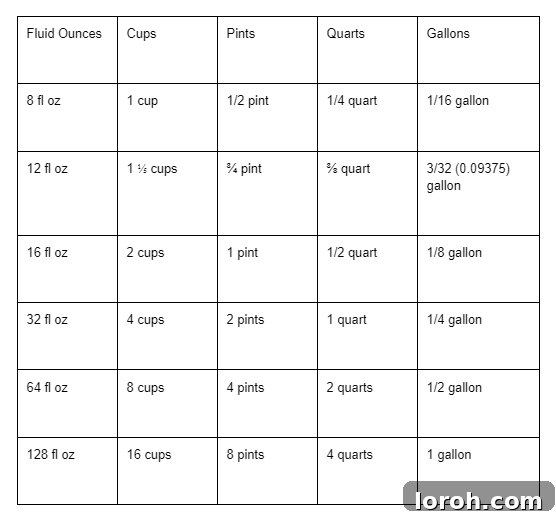
This fundamental difference is vital for anyone following recipes from different parts of the world. Always double-check which system your recipe originates from to ensure accuracy. For quick conversions, refer to the helpful chart below:
Understanding the Ounce: A Versatile Unit
The term “ounce” (oz) can be a source of confusion due to its dual nature as both a unit of weight and a unit of volume. Originating from ancient Roman units, the ounce has evolved to serve different purposes across various measurement systems.
In the U.S. Customary System, which is predominantly used in the United States, ounces are a common unit for measuring small amounts. For liquids, we use “fluid ounces” (fl oz) to denote volume. For dry ingredients, “ounces” typically refer to weight. Most other countries around the globe, however, primarily use the metric system, where grams measure weight and milliliters measure volume, simplifying the distinction.
Understanding this distinction between fluid ounces (volume) and dry ounces (weight) is paramount for precise cooking and baking, especially when scaling recipes or converting between different ingredient types.
Demystifying the Pint: A Measure of Volume
A “pint” (pt) serves primarily as a unit of volume measurement, and its definition varies significantly between the Imperial and U.S. Customary systems. Historically, the pint’s precise volume fluctuated across regions, but it largely settled into two dominant definitions:
- Imperial Pint: In countries like the UK, a pint equates to 20 fluid ounces (approximately 568.26 mL). This is the familiar size for a pint of beer in a British pub.
- U.S. Customary Pint: In the United States, a pint equals 16 fluid ounces (approximately 473.18 mL). This is roughly 20% smaller than an Imperial pint.
Pints are most commonly used to measure liquids such as milk, water, beer, and various other beverages. While less frequent in modern recipes, they can also refer to the volume of certain dry ingredients, like berries or small produce, where a “dry pint” measurement might be specified. However, for most dry ingredients like flour or sugar, weight-based measurements are preferred for accuracy.
Fluid Ounces vs. Dry Ounces: The Critical Distinction
One of the most common sources of confusion in the kitchen arises from the terms “fluid ounces” and “dry ounces.” It’s crucial to understand that these refer to different types of measurements:
- Fluid Ounces (fl oz) measure volume – how much space a liquid occupies.
- Dry Ounces (oz) measure weight – how heavy a dry ingredient is.
This distinction is vital because ingredients have different densities. For instance, a cup of flour weighs significantly less than a cup of sugar, even though they both occupy the same volume. Using a kitchen scale for dry ounces ensures precision that volume measurements often cannot provide for dry ingredients.
Fluid Ounces Explained:
- Definition: Fluid ounces (fl oz) are units of volume used specifically for liquids. They quantify the space a liquid occupies.
- Usage: Commonly used in recipes for measuring liquid ingredients like water, milk, oil, juice, broths, and alcoholic beverages.
- Representation: Often denoted by “fl oz” or sometimes just “oz” when context clearly implies liquid measurement. A liquid measuring cup, typically transparent with a spout, is used for fluid ounces.
- Conversion: 1 U.S. fluid ounce is approximately equal to 29.57 milliliters in the metric system. 1 Imperial fluid ounce is approximately 28.41 milliliters.
- Examples: A standard U.S. cup of water typically equals 8 fluid ounces. A common soda can holds 12 fluid ounces.
Dry Ounces Explained:
- Definition: Dry ounces (oz) are units of weight used for solid or granular ingredients. They quantify the mass of an ingredient.
- Usage: Essential for measuring dry ingredients like flour, sugar, grains, spices, chocolate chips, and nuts, especially in baking where precision is key.
- Representation: Always denoted by “oz” without additional symbols. A kitchen scale is the most accurate tool for measuring dry ounces.
- Conversion: 1 dry ounce (avoirdupois ounce) is equal to approximately 28.35 grams in the metric system.
- Examples: A standard cup of all-purpose flour typically weighs around 4.25 dry ounces (when spooned and leveled). A cup of granulated sugar weighs approximately 7 dry ounces.
In summary, remember: fluid ounces measure liquid volume, while dry ounces measure dry weight. Understanding this distinction is not just helpful, it’s absolutely essential for accurate measurement and consistent results in your cooking and baking endeavors.
Navigating Measurement Systems: US, Imperial, and Metric
The global culinary landscape is rich and diverse, but so are its measurement systems. Understanding the nuances of the U.S. Customary, Imperial, and Metric systems is vital for accurately interpreting recipes from around the world.
The U.S. Customary System:
Primarily used in the United States, this system is a direct descendant of the British Imperial System, but with some crucial differences. Key conversions include:
- 1 U.S. liquid pint = 16 fluid ounces (approx. 473.18 milliliters)
- 1 U.S. cup = 8 fluid ounces
- 1 U.S. quart = 2 U.S. pints (32 fluid ounces)
- 1 U.S. gallon = 4 U.S. quarts (128 fluid ounces)
Dry measurements are often given in “dry ounces” (weight) or “dry pints” (volume for specific items like berries), but the latter is less common in everyday cooking for ingredients like flour or sugar.
The Imperial System:
Still prevalent in the United Kingdom and some former British colonies, the Imperial system shares many unit names with the U.S. system but has different values. This is where most conversion errors can occur.
- 1 Imperial liquid pint = 20 fluid ounces (approx. 568.26 milliliters)
- 1 Imperial cup = 10 fluid ounces (though “cups” are less commonly used for measuring than in the US, often preferring weight or milliliters)
- 1 Imperial quart = 2 Imperial pints (40 fluid ounces)
- 1 Imperial gallon = 4 Imperial quarts (160 fluid ounces)
The Imperial dry pint, similar to its liquid counterpart, is also approximately 20 Imperial fluid ounces in volume, but again, weight is preferred for baking dry goods.
The Metric System:
Adopted by most of the world, the metric system offers a straightforward, decimal-based approach to measurement, simplifying conversions immensely. It distinguishes clearly between mass and volume:
- Volume: Measured in liters (L) and milliliters (mL). 1 liter = 1000 milliliters.
- Mass (Weight): Measured in grams (g) and kilograms (kg). 1 kilogram = 1000 grams.
For example, a recipe might call for 500 mL of milk (approximately 1 U.S. pint) or 250 g of flour (approximately 8.8 dry ounces). The clarity of the metric system significantly reduces ambiguity in recipes and is often preferred by professional chefs for its precision.
When encountering a recipe, always check its origin or look for measurement system indicators to ensure you’re using the correct conversions. A small difference in system can lead to a big difference in outcome!
Pints in Practice: Liquid vs. Dry Volume Clarified
The concept of “wet” versus “dry” measurements can be particularly confusing when applied to pints, as the term “dry pint” often clashes with common usage in home cooking.
Let’s clarify the most important distinctions:
- Liquid Pint: This is the most common use of the term “pint” in recipes.
- U.S. Liquid Pint = 16 U.S. fluid ounces.
- Imperial Liquid Pint = 20 Imperial fluid ounces.
These measure the volume of liquids like water, milk, and oils.
- Dry Pint (Volume): While a “dry pint” as a unit of volume technically exists, it’s rarely used for common baking ingredients like flour or sugar. It’s primarily used for measuring the volume of certain fresh produce, particularly fruits like berries or small vegetables.
- U.S. Dry Pint (volume) is equivalent to approximately 18.618 U.S. fluid ounces. It is derived from a bushel.
- Imperial Dry Pint (volume) is the same as an Imperial liquid pint, 20 Imperial fluid ounces, as the Imperial system does not distinguish between liquid and dry pints by volume.
Important Note: For dry baking ingredients like flour, sugar, or oats, recipes almost universally call for measurement by *weight* (dry ounces or grams) rather than by dry pint volume. Measuring by weight accounts for density variations and packing, leading to much greater accuracy.
To avoid confusion, remember that when a recipe calls for a “pint,” it almost always refers to a liquid pint unless explicitly stated otherwise (e.g., “1 pint fresh strawberries”). For ingredients measured by weight, you’ll see “ounces” (meaning dry ounces) or “grams,” and a kitchen scale will be your best friend.
A helpful kitchen adage to keep in mind, regardless of whether you’re dealing with wet or dry ingredients (by volume): two cups make a pint, and two pints make a quart. This applies to both U.S. and Imperial systems, though the volume of the cups, pints, and quarts themselves will differ between the systems.
Tips for Accurate Measurement in the Kitchen
Achieving perfect results in cooking and baking hinges on accurate measurements. Here are essential tips to ensure your conversions and ingredient quantities are always spot on:
1. Use the Right Tools:
- Liquid Measuring Cups: These are typically clear, have a spout for pouring, and feature markings at various fluid ounce and cup intervals. Always place them on a flat surface.
- Dry Measuring Cups: Designed to be filled to the brim and leveled off, these typically come in sets (e.g., ¼ cup, ⅓ cup, ½ cup, 1 cup) and are best for dry ingredients measured by volume.
- Kitchen Scale: Indispensable for measuring dry ingredients by weight (dry ounces or grams). This is the most accurate method for ingredients like flour, sugar, and grains, as it eliminates variables like packing density.
- Measuring Spoons: For small quantities of both wet and dry ingredients (teaspoons, tablespoons).
2. Techniques for Liquid Ingredients:
When measuring liquids using a liquid measuring cup:
- Eye Level: Place the measuring cup on a flat, level surface and bend down to eye level with the measurement line.
- Read the Meniscus: For most liquids, a slight curve (meniscus) will form at the surface. Read the bottom of this curve for the most accurate measurement.
- Pour Carefully: Pour slowly to avoid overfilling or spillage, especially when approaching the desired line.
3. Techniques for Dry Ingredients (by Volume):
If a recipe insists on measuring dry ingredients by volume (using dry measuring cups):
- Spoon and Level Method (for flour): Lightly spoon flour into your dry measuring cup until it overflows. Do not pack it down. Then, use a straight edge (like the back of a knife or a ruler) to level off the excess. This prevents compacting the flour and adding too much.
- Pack for Some Ingredients: Brown sugar, and sometimes shortening, are exceptions. Pack these firmly into the measuring cup until they hold their shape when inverted.
- Granulated Sugar/Salt: Simply scoop and level for these free-flowing ingredients.
4. The Gold Standard: Measuring Dry Ingredients by Weight (Dry Ounces/Grams):
For maximum accuracy, especially in baking, a kitchen scale is your best friend. Weighing ingredients:
- Eliminates Variables: Factors like how densely flour is packed or the size of individual sugar crystals become irrelevant.
- Ensures Consistency: Your recipes will turn out the same every time.
- Easier Cleanup: Often, you can measure multiple ingredients into the same bowl, taring the scale back to zero each time.
By adopting these simple yet effective measurement practices, you’ll significantly improve your cooking and baking outcomes, making conversions from ounces to pints (and vice versa) a breeze.
Why Precision Matters: The Impact on Your Recipes
In cooking, especially baking, measurements aren’t just suggestions; they are crucial instructions that dictate the chemical reactions and structural integrity of your dish. Understanding how many ounces are in a pint, and accurately converting between units, can be the difference between a culinary triumph and a kitchen flop.
- Baking is Chemistry: Baking is a precise science. The ratio of flour to liquid, leavening agents to sugar, all profoundly affect the texture, rise, and flavor. A few extra fluid ounces of milk or a few too few dry ounces of flour can completely alter a cake’s crumb or a bread’s density.
- Consistency is Key: If you want your favorite recipes to taste the same every time you make them, precise measurements are non-negotiable. This consistency builds confidence in your cooking and ensures reliable results for family and guests.
- Scaling Recipes: When doubling a recipe or halving it, accurate conversions from pints to ounces (or other units) are essential. Errors are magnified when scaling, making initial precision even more critical.
- International Recipes: Many fantastic recipes originate from countries using different measurement systems. Without a solid understanding of conversions and the distinctions between U.S. Customary and Imperial pints/ounces, adapting these recipes can be a guessing game, leading to disappointing outcomes.
By investing a little time to master these fundamental conversions and measurement techniques, you’re not just learning numbers; you’re building a foundation for greater culinary confidence, creativity, and consistent success in your kitchen adventures.
Frequently Asked Questions
In the United States customary system, a liquid pint consists of 16 fluid ounces. Conversely, in the Imperial system, as utilized in countries like the United Kingdom, a liquid pint contains 20 fluid ounces. It’s crucial to note the difference depending on which system of measurement your recipe uses.
In the context of fluid ounces to pints: one U.S. fluid ounce equals 0.0625 U.S. liquid pints (1/16th of a pint). One Imperial fluid ounce equals 0.05 Imperial liquid pints (1/20th of a pint).
A U.S. liquid pint is 16 fluid ounces (approximately 473 mL), while an Imperial liquid pint is 20 fluid ounces (approximately 568 mL). The Imperial pint is about 20% larger than the U.S. pint.
No, not usually in terms of volume or common usage. A “liquid pint” measures liquid volume. A “dry pint” (as a volume measure for produce) is slightly larger than a U.S. liquid pint. However, for most dry baking ingredients like flour or sugar, “dry ounces” refer to weight, not volume, and a kitchen scale should be used for accuracy instead of trying to measure in “dry pints.”
In both the U.S. Customary and Imperial systems, there are 2 cups in 1 pint. However, the volume of a “cup” itself differs between the systems (1 U.S. cup = 8 fl oz; 1 Imperial cup = 10 fl oz).
More Helpful Resources
- How Many Tablespoons Are in a Cup? (A Conversion Guide)
- Melting Chocolate: A Guide
- Baking Powder Vs. Bicarbonate of Soda
- How to Turn Plain Flour Into Self-Raising Flour