
Master the art of precise liquid measurements! This comprehensive guide reveals exactly **how many ounces are in a liter** and equips you with the knowledge to confidently convert between imperial and metric units for any recipe or project.
Are you frequently faced with the challenge of converting between ounces and liters in your kitchen, laboratory, or daily life? Whether you’re a passionate home baker tackling an international recipe, a professional chef adapting to diverse ingredient lists, or simply someone who needs to understand liquid volumes for health and nutrition, accurate measurement is paramount. The global disparity between the imperial and metric systems often leads to confusion and potential errors. While online calculators offer a quick solution, understanding the underlying principles of conversion empowers you with greater control and confidence, ensuring perfect results every time.
This guide aims to demystify the ounces-to-liter conversion, providing clear explanations, practical charts, and essential tips. We’ll explore the differences between measuring systems, define what an ounce and a liter truly represent, and offer actionable advice for navigating various measurement scenarios with ease. Say goodbye to guesswork and embrace precision – you’re about to become a conversion expert!
Table of Contents
- The Importance of Accurate Measurement
- Quick Conversion Guides and Charts
- Fluid Ounces to Liters Conversion
- Liters to Fluid Ounces Conversion
- Imperial vs. Metric System: Understanding the Differences
- Tips for Seamless Measurement Conversions
- What Exactly Is an Ounce?
- What Exactly Is a Liter?
- Practical Applications and Real-World Scenarios
- Frequently Asked Questions
- In Conclusion: Mastering Liquid Conversions
- More Helpful Resources
The Importance of Accurate Measurement
In countless aspects of life, from culinary creations to scientific experiments and even personal health management, accurate measurement of liquids is not just a recommendation—it’s a necessity. Imagine baking a delicate cake where the ratio of wet to dry ingredients is critical, or preparing a precise solution in a laboratory. Even minor discrepancies in volume can lead to drastically different outcomes, affecting flavor, texture, chemical reactions, or potency. The ability to flawlessly convert between different units, particularly ounces and liters, therefore becomes a vital skill that ensures consistency, reliability, and ultimately, success in your endeavors.
The United States primarily operates on the imperial system, utilizing units like pints, quarts, and gallons, while most of the world has embraced the metric system, with its base-10 units such as milliliters and liters. This global difference necessitates a robust understanding of conversions. Whether you’re following a recipe from a European cookbook, purchasing beverages internationally, or simply trying to understand the nutritional information on a product, knowing how to convert fluid ounces to liters and vice versa will save you time, prevent costly mistakes, and open up a world of possibilities.
Quick Conversion Guides and Charts
To assist you in your conversion tasks, we’ve compiled easy-to-read charts that serve as quick reference guides. These tables will help you bridge the gap between the imperial fluid ounce and the metric liter, ensuring you always have the right measurement at your fingertips. Familiarize yourself with these values, and you’ll find yourself converting with increasing speed and confidence.
Fluid Ounces to Liters Conversion
The fundamental conversion rate to remember is that 1 fluid ounce is approximately equal to 0.0295735 liters. This precise figure forms the basis for all fluid ounce to liter conversions. When dealing with practical applications like cooking or general liquid measurement, rounding to a few decimal places is often sufficient. For instance, you might use 0.03 liters per fluid ounce for quick mental math, but for critical applications, consulting a chart or using a calculator with the full value is recommended.
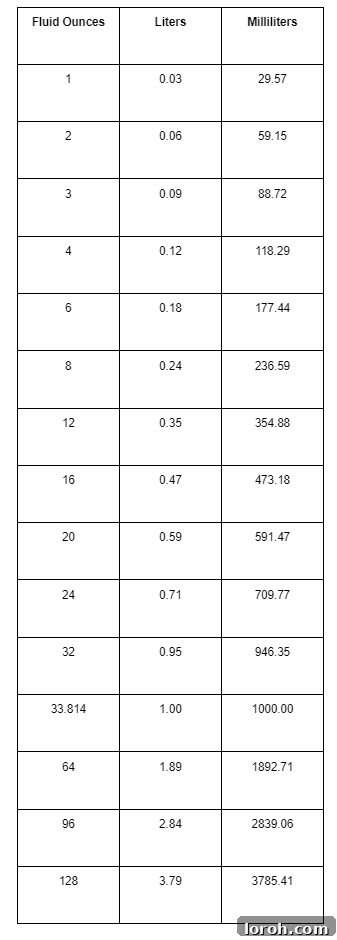
For example, if a recipe calls for 8 fluid ounces of milk and you prefer to measure in liters, you would multiply 8 by 0.0295735, which yields approximately 0.236 liters. This straightforward multiplication makes converting any fluid ounce value into its liter equivalent simple and accurate.
Liters to Fluid Ounces Conversion
Conversely, when converting liters back to fluid ounces, you need to remember that 1 liter is approximately equal to 33.814 fluid ounces. This is another critical conversion factor that will serve you well, especially when working with metric recipes or product labels and needing to understand them in imperial terms.
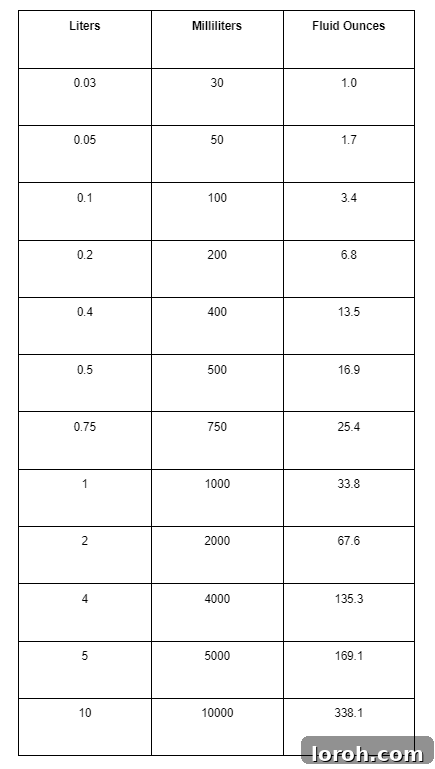
If you have a 2-liter bottle of soda and want to know its volume in fluid ounces, you would multiply 2 by 33.814, resulting in approximately 67.628 fluid ounces. These fundamental conversion rates are the backbone of effortless measurement, allowing you to adapt to any system with confidence.
Imperial vs. Metric System: Understanding the Differences
The world largely operates on two primary measurement systems: the Imperial system and the Metric system. Understanding their distinct characteristics is vital for accurate conversions and global communication, especially in fields like cooking, engineering, and commerce.
The Imperial System: Primarily used in the United States, Liberia, and Myanmar, the imperial system is characterized by a less standardized set of units, often with arbitrary conversion factors between them. For liquid volume, it employs units like:
- Fluid Ounces (fl oz): The smallest common unit for liquids.
- Cups: Typically 8 fluid ounces in the U.S.
- Pints: 2 cups or 16 fluid ounces.
- Quarts: 2 pints or 4 cups or 32 fluid ounces.
- Gallons: 4 quarts or 8 pints or 128 fluid ounces.
For weight, the imperial system uses ounces (oz) and pounds (lb), with 16 ounces making up one pound. The imperial system can sometimes be challenging due to its varied conversion factors (e.g., 12 inches in a foot, 3 feet in a yard, 16 ounces in a pound), requiring memorization of multiple distinct values.
The Metric System: Adopted by almost every other country in the world, the metric system is known for its logical and consistent base-10 structure, making conversions significantly simpler. Its primary units for volume and weight are:
- Volume:
- Milliliters (mL): A smaller unit, with 1000 mL equaling 1 liter.
- Liters (L): The standard unit for larger liquid volumes, equivalent to 1000 cubic centimeters (cm³) or one cubic decimeter (dm³).
- Weight:
- Grams (g): A small unit of mass.
- Kilograms (kg): 1000 grams, a standard unit for heavier objects.
The inherent simplicity of the metric system, where units scale by powers of ten (e.g., milli- = 0.001, centi- = 0.01, kilo- = 1000), makes calculations and conversions intuitive. This uniformity is a major reason for its global adoption and widespread use in scientific and engineering fields, where precision and ease of calculation are paramount.
Tips for Seamless Measurement Conversions
Navigating different measuring systems can be daunting, but with a few strategic tips, you can ensure accuracy and avoid common pitfalls. Precision in measurement is key to successful outcomes, particularly in cooking and baking.
- Familiarize Yourself with Key Conversion Factors: Before you even start cooking or undertaking a project, take a moment to review the main conversion rates for ounces to liters (1 fl oz ≈ 0.02957 L) and liters to ounces (1 L ≈ 33.814 fl oz). Having these numbers readily accessible or committed to memory will significantly speed up your process and reduce errors.
- Prepare the Right Tools: Invest in a good set of measuring tools that cater to both imperial and metric systems. This includes clearly marked liquid measuring cups (with spouts for easy pouring) in both milliliters/liters and fluid ounces, as well as a reliable kitchen scale that can switch between grams/kilograms and ounces/pounds. Using the correct tool for the unit specified in the recipe can eliminate the need for conversions entirely.
- Stick to One System Per Recipe: Once you start a recipe, try to stick to either the imperial or metric system throughout. Mixing units halfway through can lead to confusion and cumulative errors. If a recipe provides measurements in one system and you prefer another, convert all ingredients upfront before you begin.
- Always Double-Check International Recipes: Recipes originating from outside the U.S. will almost certainly use the metric system. Pay close attention to unit labels (e.g., “mL” vs. “fl oz”) and be prepared to convert. Some international recipes might even use volume measurements that differ slightly from U.S. standards (e.g., British Imperial fluid ounces are slightly different from U.S. fluid ounces, though this distinction is less common now).
- Measure Liquids at Eye Level: When using liquid measuring cups, always place the cup on a flat surface and view the measurement at eye level. This prevents parallax error, where the liquid level appears higher or lower than it actually is depending on your viewing angle, ensuring a more accurate reading.
- Consider Specific Gravity for Weight-to-Volume: While this guide focuses on fluid volume, remember that a “fluid ounce” is a measure of volume, not weight. An “ounce” can also be a measure of weight. The weight of a fluid ounce of water is different from a fluid ounce of oil or honey due to varying densities (specific gravity). When a recipe provides weight (e.g., “ounces of flour”) and you need to convert to liquid volume, this becomes a more complex calculation involving the ingredient’s density. Stick to volume-to-volume conversions for liquids like water, milk, or juice.
What Exactly Is an Ounce?
The term “ounce” can be a source of confusion due to its dual meaning as both a unit of weight and a unit of volume. In the context of converting to liters, we are primarily concerned with the **fluid ounce (fl oz)**, which is a unit of volume specifically used for liquids.
Historically, the ounce (from the Latin “uncia,” meaning a twelfth part) has roots in various measurement systems. Today, the fluid ounce is predominantly used in the United States, Liberia, and Myanmar. It’s an integral part of the imperial system for measuring small quantities of liquids. For example, beverage sizes, ingredient measurements in recipes, and even the volume of medications are often expressed in fluid ounces.
It’s crucial to distinguish the fluid ounce from the avoirdupois ounce, which is a unit of weight. While a fluid ounce of water weighs approximately one avoirdupois ounce, this is a coincidence specific to water and does not apply to other liquids or dry ingredients. Therefore, when you see “ounces” in a recipe context, always clarify whether it refers to fluid ounces (for liquids) or weight ounces (for dry ingredients or when using a scale). This guide, specifically, centers on the **fluid ounce** and its conversion to liters.
What Exactly Is a Liter?
A **liter (L)** is the fundamental unit of volume measurement within the metric system. Its definition is elegantly simple and universally understood, making it the preferred unit for liquid measurement across most of the globe. Conceptually, a liter corresponds to the volume of a cube with sides measuring 10 centimeters (or one decimeter) in length. This means one liter is equivalent to 1,000 cubic centimeters (cm³) or one cubic decimeter (dm³).
The metric system’s base-10 structure makes the liter incredibly convenient for scaling measurements. For instance, there are 1,000 milliliters (mL) in one liter, making it easy to convert between smaller and larger metric units by simply moving the decimal point. This logical progression simplifies calculations and reduces the potential for error, which is why the liter is extensively employed in various contexts, including packaging of beverages, fuel measurement, and scientific research. Understanding the liter is key to interacting with international products and recipes and is a gateway to precision in a globally interconnected world.
Practical Applications and Real-World Scenarios
The ability to confidently convert between ounces and liters extends far beyond the kitchen. This skill proves invaluable in numerous practical applications and real-world scenarios:
- International Cooking and Baking: Perhaps the most common use case. Many delicious recipes from Europe, Asia, and other metric-using regions will list liquid ingredients in milliliters or liters. Your newfound conversion expertise will allow you to explore a wider range of culinary traditions without hesitation.
- Beverage Consumption and Nutrition: When monitoring fluid intake for health reasons, or comparing bottle sizes and nutritional labels from different countries, conversions become essential. For example, understanding that a 500mL bottle is roughly 16.9 fluid ounces helps you track your daily water consumption more accurately.
- Gardening and Household Tasks: Mixing fertilizers, pesticides, or cleaning solutions often requires precise liquid measurements. Product instructions might be in one system, while your measuring tools are in another. Accurate conversions ensure effectiveness and safety.
- Travel and Shopping: When traveling abroad, you’ll encounter products labeled in liters (e.g., milk, soda, shampoo). Knowing the equivalent in fluid ounces helps you gauge value and quantity based on what you’re accustomed to.
- Home Brewing and Winemaking: Enthusiasts in these hobbies frequently work with larger volumes of liquids, and recipes or equipment specifications might come in different units, making conversions a regular part of the process.
- Educational and Scientific Contexts: Students and professionals in chemistry, biology, and other sciences routinely perform liquid volume conversions as part of their experiments and data analysis.
By mastering these conversions, you’re not just learning numbers; you’re gaining a practical skill that enhances your efficiency and understanding in a multitude of everyday and specialized situations.
Frequently Asked Questions
Since 1 liter is approximately 33.814 fluid ounces, and an 8 oz glass holds 8 fluid ounces, you would divide 33.814 by 8. This gives you approximately 4.23 8 oz glasses of water in a liter. So, just over four standard 8-ounce glasses will fill a 1-liter container.
No, 32 fluid ounces is not exactly equal to one liter. One liter is equivalent to approximately 33.814 fluid ounces. Therefore, 32 fluid ounces is slightly less than one liter, by about 1.814 fluid ounces.
No, 2 liters is not equal to 64 fluid ounces. As 1 liter is approximately 33.814 fluid ounces, 2 liters would be approximately 2 * 33.814 = 67.628 fluid ounces. So, 2 liters is significantly more than 64 fluid ounces, by about 3.628 fluid ounces.
Canada officially uses the metric system, so when discussing standard measurements, liters are primary. However, the conversion rate between a liter and a fluid ounce remains constant globally. There are approximately 33.814 U.S. fluid ounces in one liter. While Canada might use metric units predominantly, if you were to convert a Canadian liter measure to U.S. fluid ounces, the conversion factor is still the same.
This distinction is crucial due to density. “Ounces” as a unit of weight (avoirdupois ounce) measures mass, while “fluid ounces” measures volume. For dry ingredients like flour or sugar, their volume can vary significantly based on how they’re packed (sifted vs. packed). Weighing them in ounces provides a more consistent and accurate measurement regardless of packing. Liquids, on the other hand, have a more consistent density and conform to the shape of their container, making volume (fluid ounces or milliliters) a reliable measurement.
No, they are slightly different. A U.S. fluid ounce is approximately 29.5735 milliliters, while an Imperial fluid ounce (used in the UK and some Commonwealth countries traditionally) is approximately 28.4131 milliliters. This difference is small but can be significant for very precise measurements or large quantities. This guide primarily focuses on U.S. fluid ounces for clarity, as it’s the more commonly encountered imperial unit in global contexts.
In Conclusion: Mastering Liquid Conversions
Navigating the world of liquid measurements no longer needs to be a source of frustration. By understanding the core conversion rates – that 1 liter equals approximately 33.814 fluid ounces and 1 fluid ounce equals about 0.02957 liters – you are now equipped with the fundamental knowledge to bridge the gap between the imperial and metric systems. We’ve explored the distinct characteristics of each system, provided practical conversion charts, and offered valuable tips to ensure accuracy in all your culinary and practical endeavors.
From adapting international recipes to simply understanding the volume of your favorite beverages, mastering these conversions empowers you with confidence and precision. Embrace the simplicity of these guidelines, utilize the quick reference charts, and apply the practical tips, and you will undoubtedly achieve consistent and excellent results in every project requiring liquid measurement. Happy converting!
More Helpful Resources
- How Many Ounces in a Pound (A Comprehensive Conversion Guide)
- How Many Ounces in a Pint? (Your Essential Conversion Guide)
- How Many Ounces Are in a Cup? (Exploring Dry and Liquid Measurements)
- How Many Ounces Are in a Quart? (A Detailed Conversion Guide)
- Grams to Ounces: Mastering Weight Conversions